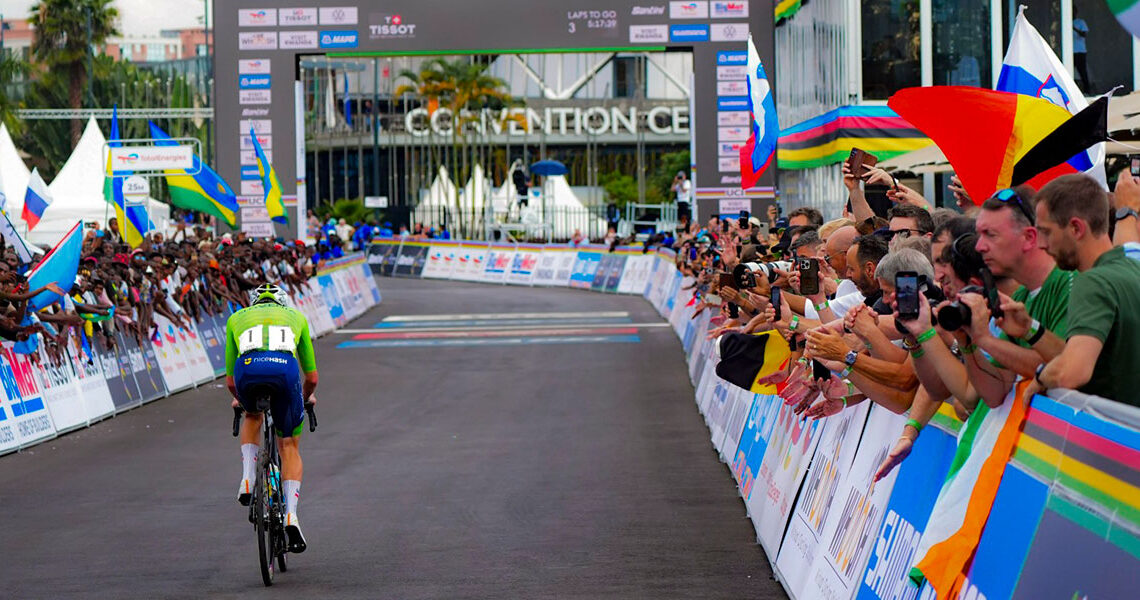

World Championships week is always a whirlwind of questions, predictions, and “what-ifs,” and the 2025 edition in Kigali, Rwanda, delivered on every front. From the opening meters on one of the toughest courses in recent memory, fans were glued to every attack, climb, and counterpunch, trying to figure out who had the legs, the guts, and the strategy to take the rainbow jersey. By the finish, some pre-race theories were blown apart, new storylines had exploded onto the scene, and one thing was certain: Kigali didn’t just answer questions—it raised plenty more, setting the stage for Montreal 2026.
The analysis of upcoming races can go on for weeks during the build-up, depending on the race’s significance, culminating in major articles with analysis of the main contenders and podium predictions. The amount of interest is at its peak because everyone’s questions are still unanswered. After the race, everyone knows the same answers to all their questions. This year’s World Championship in Kigali, Rwanda, answered the pre-race questions but also raised new ones, some of which will go unanswered until next year.

The Hardest World Championship Course in Years
But before we get to the questions and answers, the race was 267.5 km long with approximately 5700 meters of climbing. The course consisted of nine laps on a 15.1 km loop in Kigali (which included two climbs per lap, the Kigali Golf climb, 0.8 km at 8.1%, and the cobbled Côte de Kimihurura, 1.3 km at 6.3%); a longer loop of 42.5 km that tackled the three longer climbs of the day (Côte de Péage, 1.8 km at 5.9%, Mont Kigali, 5.9 km at 6.9%, and the Mur de Kigali, 400 meters at 11%); and a return to the Kigali circuit for another six laps. In short, this course was being billed as the hardest World Championship road race, perhaps the hardest one-day race, in years.

Pogačar vs. Evenepoel: Who Had the Edge?
The big question everyone had going into the 2025 UCI World Championship road race was whether Remco Evenepoel catching Tadej Pogačar for two and a half minutes in the time trial a week before (to some, the most shocking moment of the 2025 season) meant that Pogačar was sub-par and beatable, by Evenepoel in particular, in the road race. Not only had Pogačar seemed exhausted after the Tour, talking about retirement and training in a “do not disturb” jersey as a message to fans for space, but some thought he didn’t dominate GP Montreal the way he did in 2024 and let off the gas so his UAE teammate Brandon McNulty could catch up and gifting him the win.
As a fan, I was looking for pre-race signs that Pogačar was going to get his sporting revenge on Evenepoel, and I found what I thought were two of them: first, during an interview after the time trial but before the road race, Pogačar said “I am here in general for the road race.” To me, that translated to something along the lines of “hold my beer and wait for the road race.” Second, in the time trial, Pogačar adjusted his helmet straps. To me, this was much like the drink of water he took during his TT loss at the Dauphine before he went on to dominate that race in the mountains—a sign that he wasn’t going 100% in the time trial and was waiting for another objective. If you’re taking a time trial seriously, you don’t take sips of water (in a short test) or adjust your helmet straps because every second counts.
I thought I knew the answer when I saw Evenepoel’s face in the approach to Mont Kigali and also when I saw Pogačar intentionally decline a sticky bottle during what seemed like a difficult chase back from a nature break. Evenepoel looked tense and Pogačar seemed to be saying “I’m going too good for a sticky bottle.”
But the question was answered in earnest when Pogačar attacked with 104km to go on the slopes of Mont Kigali and Evenepoel was unable to match Pogačar’s attack for more than a few dozen meters. Only Juan Ayuso (Spain) was able to follow Pogačar over the top of Mont Kigali, with Isaac Del Toro (Mexico) absolutely railing the descent to catch the duo and briefly make it an all-UAE trade team breakaway (at least until December 31, when Ayuso officially leaves for Lidl-Trek).
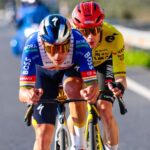
The steep ramps of the Mur de Kigali would come sooner than Ayuso’s departure from UAE, and Ayuso cracked hard leaving just Del Toro and Pogačar at the front by just under a minute to the chase group. Pogačar seemed to nurse Del Toro through at least one difficult moment on the cobbles but eventually left him behind on the Kigali Golf climb with about 66 km to go. Although Evenepoel rallied for an impressive silver medal (answering another related question relating to his form, which hadn’t seemed great at the Tour), it was clear that his drubbing of Pogačar in the TT didn’t mean all that much after all.

Now that he’s attacked, can he stay away?
The biggest question that arose after Pogačar’s attack could have been predicted beforehand, given Pogačar’s success with long-range attacks in hilly road races, and is the one question that dominated the closing laps of the race: now that he’s attacked, can he stay away? Pogačar held a gap of between thirty seconds and one minute for about fifty kilometers, never quite pushing himself out of reach of the chasers until the very end. It was as exciting to watch as any solo breakaway that seems almost sure to succeed; maybe because the group behind kept it close and maybe because Pogačar is such a popular rider. Either way, Pogačar showed that any doubts about his form were misplaced.
Alaphilippe’s Illness and the French Team’s Hopes
Julian Alaphillipe (France), a two-time World Champion (and formerly a member of the top-dog group of racers, along with Pogačar, Mattieu Van der Poel, Roglic, and other superstars) was talked up as a possible dark horse given his current run of form, but the answer to the question of whether he could turn back the years at Worlds came almost immediately when he was dropped about twenty kilometers into the race, a victim of a pre-race illness according to initial reports. However, he put in some digs before he was dropped, thereby answering another question, i.e., whether Alaphilippe is too self-important to start a race sick and do some efforts for a team leader. In short, he isn’t (unlike, perhaps, some others). This has to be a win, of sorts, for Alaphilippe.

What Happened to the Italians
Like Alaphilippe in the French team kit, the sight of the Italian maglia azzuri gives me nostalgic goosebumps, making me question whether the Italian team could resurrect itself into something like the dominant worlds squad of years before. Giulio Ciccone’s sixth place doesn’t quite do the jersey justice but, given that there were only thirty finishers, it’s a more than respectable result and an honest answer: good, but not as good as the Italian teams of yesteryear.
 Del Toro attacked, Ayuso cracked on the Mur.
The Ayuso Question
Another big question seemingly on everyone’s lips was whether Ayuso, liberated from any domestique duties at UAE and seemingly with a point to prove, would be able to challenge for the win. Having just broke his long-term contract with UAE to sign another long-term deal with Lidl-Trek and having generated some bad press during his assistance (or lack thereof) to João Almeida at the Vuelta, he must have been feeling the pressure, internal and external, for a big result. That pressure showed in his immediate reaction to Pogačar’s attack—he was attentive and clearly motivated—but unfortunately it also showed when he cracked, perhaps having overextended himself as a result of all that pressure. While Ayuso battled back to finish eighth, his performance raised more questions about whether Ayuso can compete against the biggest stars after the meteoric start to his career seems to have come back to earth.

Skjelmose vs. Ayuso: Lidl-Trek’s Future GC Leaders
Relatedly, another question I had before the race was how Mattias Skjelmose, current GC leader at Lidl-Trek, would respond on the road to Ayuso signing with Lidl-Trek, presumably to be the team’s GC leader, especially after reading that Skjelmose had talked some trash (at least by World Tour racers’ standards) about Ayuso’s signing. Skjelmose let his legs do, or continue, the talking, making the three-man chase with Evenepoel and Ben Healy (Ireland) that kept Pogačar at about a minute and eventually finishing a very impressive fourth place. This was the most effective message he could have sent to Lidl-Trek and to Ayuso himself: Ayuso may be hyped, but Skjelmose gets consistent results.
¡Ándale México! Del Toro’s Support Squad
Given Del Toro’s favorite status, we had to question whether Mexico could provide him any support at all. This question was answered when, during the last couple laps of the Kigali circuit before heading out on the extended loop, Mexico’s Eder Frayer started doing what seemed like a foolhardy amount of work on the front for Del Toro. Frayer’s efforts seemed like they would be short-lived at best, but he continued to work at the front onto the extended loop, past the Côte de Péage, and he was still working for Del Toro when the bunch hit Mount Kigali. Given that Frayer’s work arguably set up Del Toro for his move across to the front, I have to conclude that for a small, three-person team, Mexico did an outstanding job.
Tactical Lessons from the U23s and Elite Women
Another question that came up while watching other races leading up to the Elite Men’s road race was whether one of two tactical scenarios that played out in the U23 Men’s race and the Elite Women’s race would put Pogačar’s title defense in danger. In the U23 race, the Belgian team went all-in for team leader Jarno Widar, burning off rider after rider, only to find Widar on a bad day and isolated at the end. This worry became more tangible when, as the race approached Mont Kigali, the Slovenian team started shedding riders who had been working at the front during the opening circuits. Pogačar’s attack showed that Slovenia had not made the same error of overestimating their leader’s form.
 U23 Men’s race – Belgian team leader Jarno Widar at the front.
In the Elite Women’s race, a different tactical problem arose when a break was allowed to gain too much time for the favorites to reel in before the finish, leading to a win by relative unknown (but obviously strong) Magdeleine Vallieres of Canada. The risk of Pogačar and the other favorites being caught out by a dangerous breakaway dissipated on the first lap of the race, when a break of seven (Marius Mayrhofer of Germany, Ivo Oliveira of Portugal, Fabio Christen of Switzerland, Andrea Foldager of Denmark, Menno Huising of the Netherlands, and Julien Bernard of France) got away without much opposition and built up a lead of about two and a half minutes. None of these racers were dangerous enough to cause any sort of panic in the peloton and neither the Slovenian nor the Belgian team had to exhaust themselves to bring it back, leaving them to employ their tactics as planned.

The Slovenian Bike Messenger: Matic Zumer’s Ride
On the topic of the Slovenian team, after hearing about him for the first time about a week before the race, I was particularly interested in how Matic Zumer, Pogačar’s national teammate, would perform. Apparently, Zumer is a bike messenger (and obviously fast amateur racer), who was drafted into the 2024 Slovenian World Championship squad to fill the roster and ended up doing so well that they brought him back in 2025. Zumer answered the question (i.e., whether bike messengers can compete at the top level) by working impressively at the front and lasting longer than many.
The Up & Comer Award: Paul Seixas Shines
There were also the standard pre-race questions. For example, who would be the most impressive up-and-coming racer to emerge from this Worlds? The answer to this was clearly Paul Seixas (France), but this was no surprise because he’s been impressive all season. Seixas, the youngest rider in the race at 19, briefly looked like he would make it across to the Evenepoel, Healy, and Skjelmose group (with the help of his teammate, an impressive Pavel Sivakov), and eventually finished a strong 13th. Seixas, along with Matthew Riccitello (USA) and Felix Gall (Austria), form the backbone of an increasingly impressive looking Decathlon AG2R-La Mondiale team for 2026.
Most Impressive Performance: Toms Skujiņs
Another standard pre-race question was who would surprise with an impressive performance? For me, the answer to that question has to be Toms Skujiņs (Latvia), who appeared in few pundits’ list of pre-race favorites but was ever-present and finished an impressive fifth place.
Evenepoel’s Response: From Crisis to Silver
Some questions couldn’t be asked until they presented themselves during the race. When Evenepoel cracked with just over 100 km to go, the question of how he would respond had to be on everyone’s mind. We’ve seen him battle back (for example, in the 2023 Vuelta when he was dropped out of overall contention but battled back to win three stages), but we’ve also seen him seemingly give up (for example, at this year’s Liege Bastogne Liege and Tour de France). The question seemed to be answered in the negative as Evenepoel switched bikes, complained about his saddle angle, and switched bikes again, losing a lot of time in the process. But Evenepoel battled back like a true champion and drove the three-man chase group to the finish, eventually attacking for a well-earned silver medal.
Ayuso’s Redemption After Cracking
Another question raised by race circumstances was how Ayuso would respond to being dropped by his two trade teammates. We’ve seen him be temperamental, especially recently after setbacks at the Vuelta, and I half expected Ayuso to simply quit in a huff. The fact that he battled back for a top ten result was impressive and allayed some fears of him being too egotistical to fight when he’s not in contention for the win.
 One eye-witness account reported to PEZ that Pogacar appeared to wait for McNulty to catch him in Montreal.
Looking Ahead: Questions for Montreal 2026
Finally, this race raised questions that won’t be answered until next year. How will Skjelmose and Ayuso fare as GC co-leaders at Lidl-Trek, especially after Skjelmose’s shot across Ayuso’s bow? Can Evenepoel improve to Pogačar’s level for next year’s hilly classics, setting us up for some incredible battles? Will Pogačar win three world championships in a row, something that has only been done by Peter Sagan, putting him in an elite group of three-time winners (and notching him up a level toward GOAT status)? Can either Pogacar or Evenepoel win both the road race and time trial next year, or are the demands of each race too specific to allow for the double? Will the Slovenian bike messenger be back for the 2026 Worlds? The questions will build from now until next year, when the 2026 Worlds Road Race in Montreal, Canada finally provide the answers.
Wrap It Up
The 2025 World Championships in Kigali lived up to the billing as one of the hardest and most dramatic editions in recent memory. Pogačar silenced doubts with a dominant long-range attack, Evenepoel proved his resilience with a comeback silver, and rising stars like Del Toro, Ayuso, Skjelmose, and Seixas showed flashes of what’s to come. The race not only answered the big questions fans carried into Rwanda but also sparked new storylines that will shape the sport heading into Montreal 2026. In the end, the Worlds once again reminded us why cycling’s toughest one-day race is also its most unpredictable.
The post Worlds ’25 Wrap Up: Questions & Answers appeared first on PezCycling News.