
This story originally appeared in the Spring 2025 issue of Adventure Cyclist magazine. Join today to get yours.
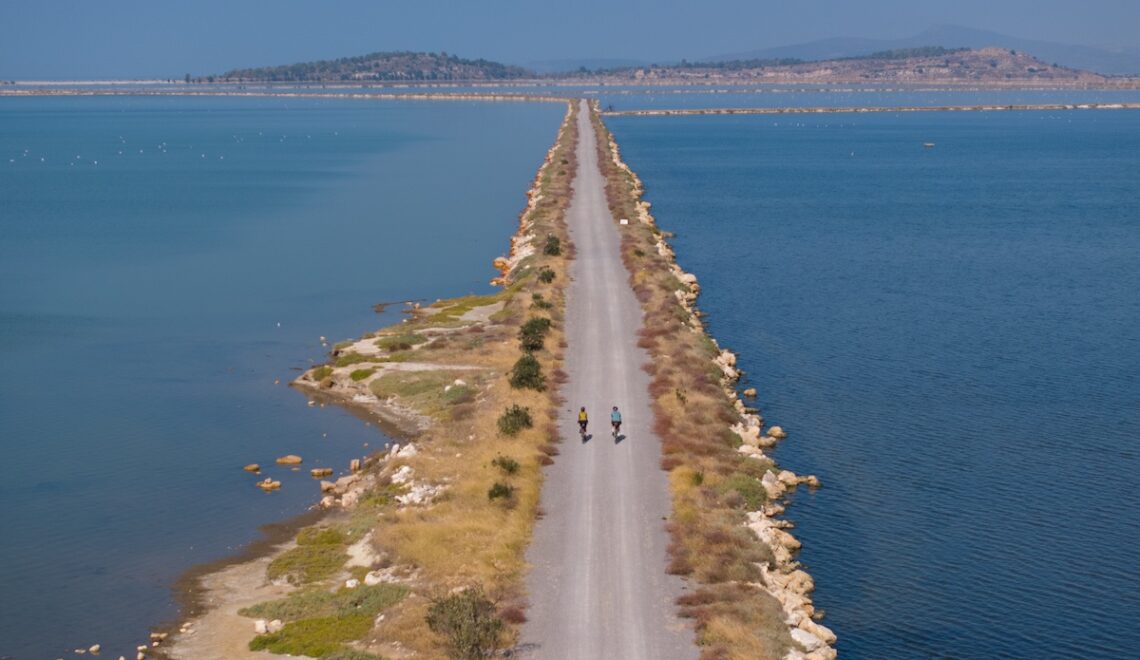
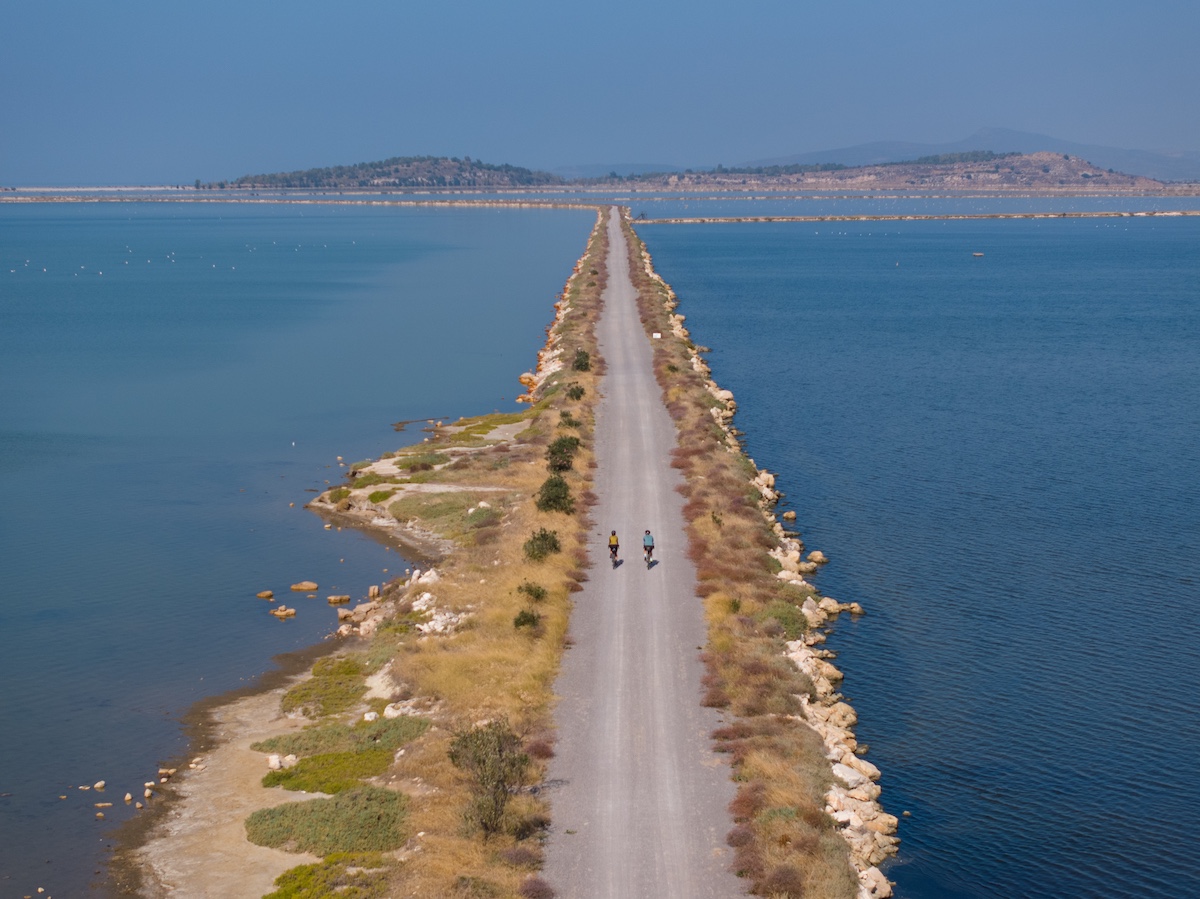
The city of Izmir rose in the distance. Until this point — midway through Türkiye’s 300-mile section of the continent-spanning EuroVelo 8 cycle route (EV8) — the ride had been a patchwork of quiet roads and packed-gravel trails snaking through small towns, fishing villages, and seaside resorts along the Aegean coast.
Protected wetlands and seagrasses sheltering flamingos suddenly gave way to high-rise apartments and office buildings. The route then funneled onto a cornflower-blue, bike-only path that took us under the glass-and-steel shell of the country’s third-largest metropolis, exposing a fertile culture that’s germinated here for 8,500 years.
Inside the city’s ancient core, my cycling partner, Pinar Pinzuti, and I took a table at a waterside cafe and ordered cappuccinos as we stared across frenetic Izmir Bay. Pinar, a member of the EuroVelo Council, an advisory board for its namesake cycling route network, grew up here but now lives in Italy. Cruise ships, cargo vessels, and sailboats crisscrossed the expanse trailed by flocks of squawking seagulls. It was a cool, bright October day, and as we waited for the ferry to take us to the bay’s southern shore and continue our journey, I jotted down notes and reflected on the multiple hats I’d worn while in Türkiye (better known in the West as Turkey).
As a travel journalist, my role was to document Türkiye’s portion of the EV8 for a growing number of globetrotting cyclists. The four-to-seven-day ride, depending on one’s fitness and off-bike interests, was officially added to the existing route just before the COVID-19 pandemic. Known as the “Mediterranean Route,” the EV8 links ten countries from Spain across more than 4,500 miles to Cyprus. Hat number two: As a sustainable-travel advocate and cycle-route developer, I’d been asked to stick around a few days after the ride to give a keynote speech, with Pinar, at the annual EuroVelo conference being held in Izmir. And, as a history buff, hat number three was self-assigned: Absorb the monumental volume of antiquity around every corner and down every alley along this ancient cultural corridor.
Looking up from my notebook, Izmir’s city center was an architectural yard sale spanning from the Hellenistic period (323 BC – 31 BC) to the present moment. Crane arms swung above the ancient harbor lofting girders to new constructions. The Agora, a stone column-lined public forum and marketplace established during Alexander the Great’s reign, still retains its basic shape, even after centuries of wars, earthquakes, fires, and floods. And while the Agora’s ruins are maintained as a historic site, vendors and shoppers laden with produce, seafood, clothes, and homegoods still buzzed in and out of the Kemeraltı Bazaar, an open-air market a 10-minute walk to the west that has operated in the city for some 2,400 years.

For much of recorded history, this stretch of the Aegean was a vortex connecting epochs and ages, empires and religions. The Hittites, Persians, Greeks, Romans, Byzantines, and Ottomans all laid claim to this region. In fact, this swath of land on the western edge of Asia Minor, which was once known as Ionia, was as crucial to the development of Western Civilization as any place on the planet. The poet Homer, the claimed author of the Iliad and the Odyssey, was born on these shores. As was Herodotus, known as the father of both history and travel, and by extension, the father of the travelogue. In a very real sense, travel writers owe their livelihoods to these two historical figures who have been called the unofficial co-founders of tourism.
“This is a place where the past and present blend seamlessly,” Pinar said as we walked our loaded gravel bikes onto the ferry alongside a mix of local commuters and pannier-toting touring cyclists. Although she was born and raised in Izmir and had ridden sections of this route over the years, Pinar was, like me, riding the entirety of Türkiye’s EV8 for the first time. “There is a deep tradition of hospitality dating back to the Silk Road, and Türkiye has always viewed travelers as guests sent by God, deserving of a warm welcome,” she said. “This heritage aligns perfectly with the principles of sustainable travel, where the emphasis is on meaningful interactions which allows both visitors and locals to benefit from rich, authentic exchanges.”

“But you, brave and adept from this day on . . . there’s hope that you will reach your goal . . . the journey that stirs you now is not far off.” ― Homer
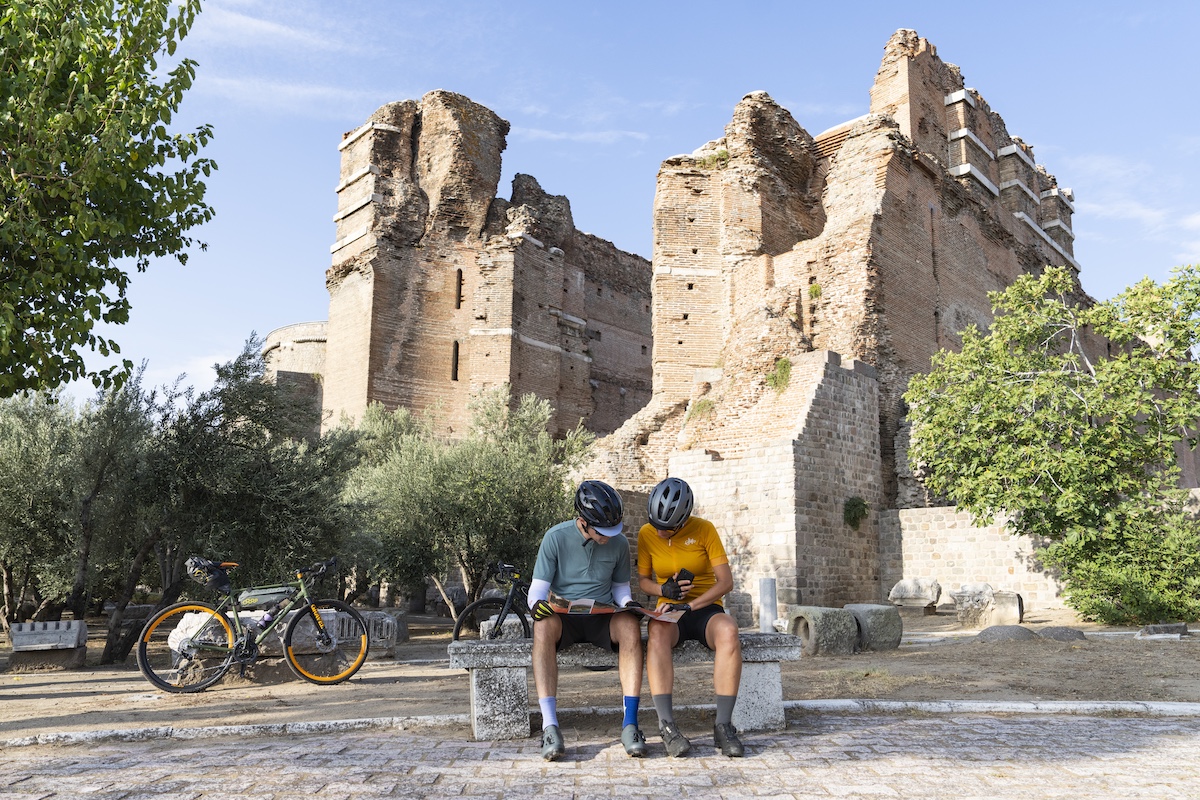
Three days earlier, jet-lagged and groggy after flying into Izmir’s international airport from the States, I met up with Pinar, whom I’d regularly rendezvoused with at cycling conferences but had never ridden with. We hopped on a shuttle with our bikes and gear and drove 67 miles north to the modern town of Bergama, the EV8’s northernmost point in Türkiye and the gateway to the ancient city of Peramon, which dates to the fifth century BC. A decade ago, Pergamon was inscribed on UNESCO’s World Heritage List for its “multi-layered cultural landscape” with “burial mounds and remains of the Roman, Byzantine, and Ottoman empires.”
We took lunch at the appropriately named Akropol Restaurant, located on a terrace below Pergamon’s actual akropol, or acropolis. Between courses, we planned our upcoming cycle stages by comparing EuroVelo’s downloadable EV8 GPX tracks on our phones to the paper maps we’d spread on the grass under the trees beside us. As waiters crowded our table with fresh bread, skewers of grilled lamb, and plates of marinated veal with stewed tomatoes and a garlic-yogurt sauce, we traced the route and circled the best spots for photos and excursions. When the servers delivered stuffed bell peppers; rolled grape leaves filled with rice, nuts, and vegetables; and sauteed eggplant topped with spicy green chili peppers, we marked spots to eat and sleep. After a dessert of helva — a confection of tahini, sesame, and molasses — we finally folded our maps and took a 10-minute cable car ride up to the ruins of one of the world’s most important historic cities.
Even in its “ruined” state, Pergamon, the chief city of the Attalid Dynasty and later the capital of Rome’s Asian Province, felt alive and vibrant. Intact columns towered over the remains of the Altar of Zeus and the temples of Athena and Dionysus. From the stone bench seats of the millennia-old, outdoor theater — built into the steep hillside of the acropolis — we could see Bergama’s tangled streets and neighborhoods some 700 feet below and two miles away. We could even make out next morning’s ride, which snaked through the distant mountains towards the sea.
“If a man insisted on always being serious, and never allowed himself a bit of fun and relaxation, he would go mad or become unstable without knowing it.” ― Herodotus
I had three flats on our opening day in the saddle. The first came just after breakfast but before leaving Bergama. I pulled to the curb, took a seat at an outdoor cafe, laughed at the tire with the waiter, and ordered an espresso. He and one of his colleagues watched as I went into autopilot, pulling out tire levers, checking for sharp objects, sliding in a new tube, and coaxing the tire back inside the wheel’s rim. I finished my espresso and we made our second attempt to leave town.
The route climbed through pine forests on asphalt roads devoid of cars. We then plunged through cornfields on dirt paths before ascending back into the pines. At the Bakırçay River, olive groves surrounded the whitewashed, one-story, stone houses that lined the cobbled streets. A group of old men sat on benches next to a public fountain and drank cups of steaming tea.
Flat tire number two.
With the village elders as an audience, I leaned the bike against a tree and shared a look with one of the old-timers. My expression: “Can you believe this luck? I suppose karma caught up with me.” His expression: “Why would anyone ride a bike up and down hills when you could relax and drink tea? I suppose karma caught up with you.” Using Pinar’s spare tube and my tire-changing warmup from earlier, I set a new flat-fixing personal best. Or at least I convinced myself as much. With the self-preserving solace of a new record born of bad fortune, we were off once again.
The EV8 continued beside the river. Then it met the sea and hugged the Aegean’s indented coast, winding along quiet streets above remote coves, where sailboats anchored for privacy. We crested easygoing hills and coasted into the troughs past pebbly beaches teeming with late-season sunbathers. The salty air mixed with the smell of suntan lotion. A DJ spun bossa nova rhythms at one shoreside bar. Nearby, a vendor sold midye — mussels stuffed with rice, pine nuts, currants, tomatoes, and onions — from a cart. Customers, barefoot and bronze, bought them by the bag, doused each with lemon wedges, scooped the contents of the loaded shells into their mouths, and washed them down with cold beer.
After 50 or so miles, the terracotta roofs of Foça appeared as the route curled into the mouth of the Gulf of Izmir. Both Herodotus and Homer were familiar with this alluring coastal town. The former chronicled its founding some 3,000 years ago. The latter, according to legend, used the cliff-strewn archipelago that surrounds it as the location of the Sirens in the Odyssey. Today, those cliffs shelter Mediterranean monk seals, among the planet’s rarest marine mammals. Foça still attracts plenty of visitors.
They come for the restaurants and bars with terraces that spill onto brick avenues lined by electric-magenta bougainvillea vines. The travelers take photos in front of the ancient castle, which has been rebuilt after each conquest to stand guard against maritime invaders. They’re also drawn to the town’s relaxed, old-world vibe. We rolled our bikes past fishermen mending nets next to skiffs as seemingly disinterested cats sprawled on the bows hoping for charity.
Flat number three (this time the front tire) had been a slow leaker, until it wasn’t. I’d felt it coming on for several miles, but pride wouldn’t let me stop. I was riding the rim as we pulled into our boutique hotel in the center of Foça’s old town. While checking in, the receptionist saw my bike upside down on the sidewalk. He could sense that after riding 60 miles across the countryside, fixing it wasn’t my top priority. Moments later, I sat with the sinking sun on my face and a can of local Efes pilsner in my hand.
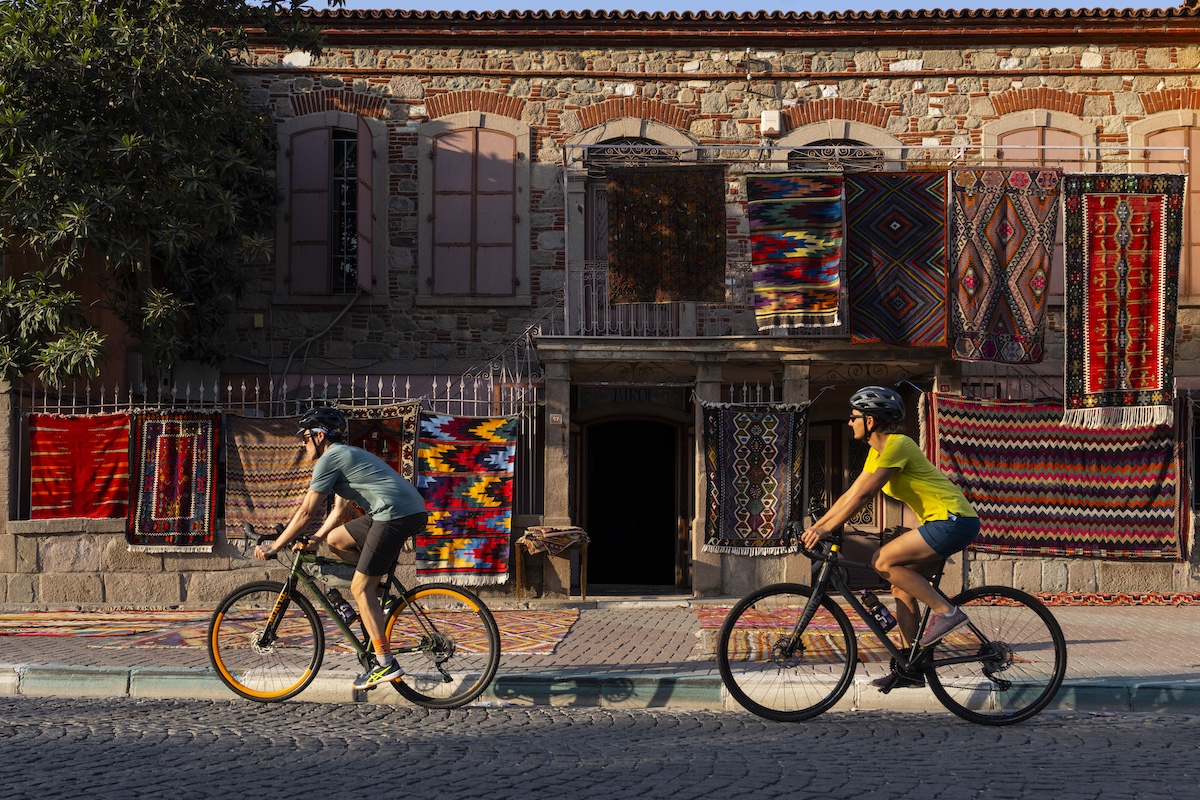
The EV8 is part of the wider EuroVelo cycling network, which is managed by the European Cyclists’ Federation (ECF), an umbrella organization that advocates for “cycling as a sustainable and healthy means of transport and leisure.” Conceived 30 years ago this year, the network’s first route, the North Sea Cycle Route (now the EuroVelo 12), opened in 2001. Today, its 17 routes (odd-numbers go north-south, even numbers eastwest) connect cities and villages, roll along rivers, and provide access to coastlines and mountains. They take travelers around the continent on streets, bike paths, gravel tracks, and forest roads, linking 40 countries and covering more than 55,000 miles.
For cyclists looking for Odyssean adventure, EuroVelo’s wealth of long-distance rides and diverse experiences is unparalleled. For instance, with the addition of Türkiye’s Aegean coast, the EV8 is now a mammoth 4,567 miles long. Still, it only ranks fifth in length among EV trails. The longest is the Euro-Velo 1, the Atlantic Coast Route, which runs for 6,600 miles (the roundtrip driving distance between Seattle and Miami) from Norway’s North Cape to Valença, Portugal. The EV8 does, though, rank first for its number of UNESCO sites with 23.
But perhaps the most important role any user-friendly bicycle network plays is as a facilitator.
I have often cycled in Europe without a set plan. I’d generally known where I wanted to go and figured it out along the way. However, having detailed route descriptions via EuroVelo’s maps, websites, and apps didn’t only provide peace of mind, it also gave me confidence that there would be cycling-specific infrastructure along the way. In order to be certified, each stage of every route is rigorously evaluated against criteria such as traffic density, proximity to public transportation, and riding surface quality. The routes are also required to pass “at least one significant cultural or natural attraction” each day. I never could have conceived of many of the EV rides — with themes like the Pilgrims Route, the Capitals Route, the Iron Curtain Trail, and the Sun Route — on my own.
“We see EuroVelo as the backbone of cycle route networks in Europe, and it is already the case in many countries,” said Agathe Daudibon, cycling tourism director at the European Cyclists’ Federation. “A European initiative such as EuroVelo brings better visibility and awareness of cycling across the continent for leisure and travel but ultimately for daily transport, too.”
Another important role EuroVelo plays is facilitating sustainable tourism; and it’s not just due to cycling’s smaller carbon footprint. Each route is a business engine that gives local restaurateurs, guides, bike mechanics, hoteliers, and others a way to earn a living in their beautiful pockets of the world rather than moving to bigger cities or other countries for work. When villages thrive economically, they control their own narratives and, in turn, can more readily manage overtourism. And when travelers patronize communities that responsibly manage themselves, that’s when initiatives like Türkiye’s EV8 provide a genuinely sustainable way to experience the region well into the future.
“Cycling tourism attracts visitors who stay longer and spend more in local communities,” said Ceylan Şensoy, the director of product marketing at Türkiye’s Tourism Promotion and Development Agency. “It also aligns with global trends where travelers are increasingly seeking eco-conscious destinations that promote health and sustainability.”
In light of recent protests against overtourism in Spain, Greece, Italy, and the Netherlands, Şensoy, who calls bicycles “time machines” for experiencing her country, believes Türkiye’s inclusion in the EuroVelo network addresses the issue responsibly and imparts the right message about growth to international travelers. “Cycling in Türkiye benefits from less intensive and gentler infrastructure by preserving natural landscapes, reducing costs, and minimizing disruption to local ecosystems and communities,” Şensoy continued. “Overall, these factors enable Türkiye to court tourists positively, rather than worrying about the impacts of overtourism.”
“All men’s gains are the fruit of venturing.”― Herodotus
The next morning in Foça, we walked to the harbor for breakfast before the previous night’s revelers stirred. A seaside town’s awakening is intoxicating. Boats rocked with the motion of early risers organizing their gear. Fishermen were in transit, puttering out to the Aegean or gathering on benches to drink tea and smoke cigarettes after delivering their haul to market. Shop owners opened shutters, and cafe baristas swept stoops and hung chalkboards with the day’s offerings.
We sat for a classic Turkish breakfast on a restaurant’s patio. Within moments of ordering, our harborside table was filled with bowls of olives, savory pies made with phyllo dough called börek, a creamy cheese known as kaymak, salad, and kettles of tea. Before we had a chance to dig in, the waiters brought over another table and the second round of cycle fuel: poppy-covered simit, a cross between a bagel and a pretzel; and menemen, eggs scrambled with tomatoes, peppers, and onions.
Before heading back out onto the road, we strolled through the shops in the old town. Pinar walked straight to one selling dozens of variations of a circular, eye-like ornament made of blue glass known as a nazar. There were nazars as large as dinner plates, strung with twine, meant to hang near a home’s front door. There were keychains, bracelets, necklaces, and earrings. Pinar walked to a box and picked up a loose, quarter-sized version. It cost 50 Turkish Liras, or about $1.50.
“Put this in your pocket,” she said. “It is very important in Turkish culture. The nazar protects against the evil eye, and it is best if someone gives it to you. After watching you change three flats in one day, I believe you can use it.”
From Foça, the route paralleled the coast as it entered the Gulf of Izmir and rolled across flat farmland. Sunflowers and cotton played leapfrog with olive groves. The horizon was broken by distant foothills framing homes surrounded by cypress trees.
We cycled to the Gediz Delta, a bird watcher’s dream, along well-maintained gravel roads to the Izmir Bird Paradise visitor center. Its nearly 20,000 acres of protected wetlands flanking the Gulf of Izmir were astir with a smattering of the approximately 300 species of birds (28 endangered) found here: black storks, Dalmatian pelicans, sandpipers, egrets, kingfishers, and oystercatchers. It is, however, the flamingos that people come to see. Around ten percent of the world’s Phoenicopterus roseus, or greater flamingos, call this area home. We watched a group peck the sandy shallows looking for the shrimp that give them their pink color. When we rode by, the flamboyance took flight, formed a chevron, and relocated to another bed of sea grasses.
After our breakfast in Izmir during which I contemplated my many hats and our ferry ride to Izmir Bay’s southern shore, the EV8 continued down the coast through the beach-resort community of Urla, known for Michelin-starred cuisine, wine, and its perched old town full of market squares. We pedaled under blue skies through vineyards laid across the undulating hills like massive bolts of corduroy. The grape harvest was winding down, the season’s product barrelled, and the earthy smell of fermentation filled the air.
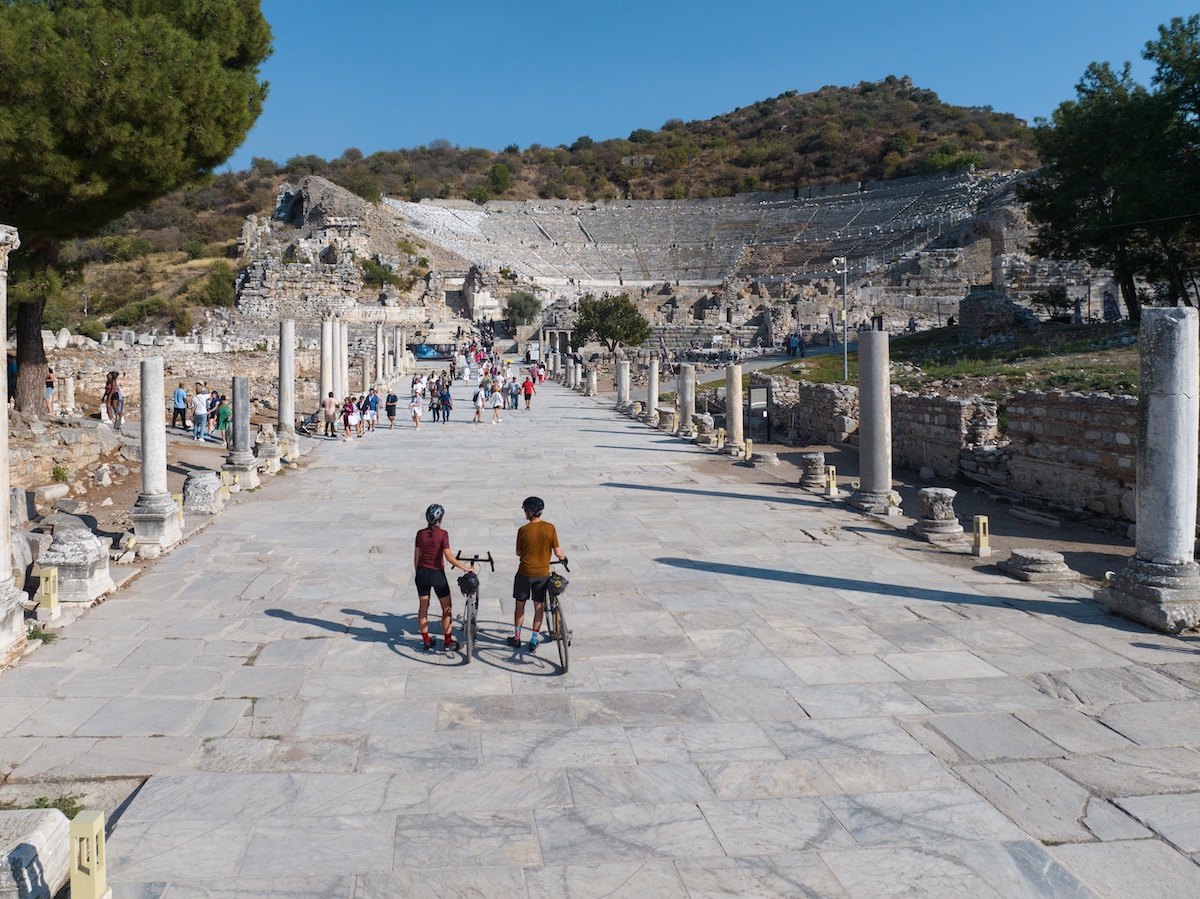
Our odyssey ended 50 or so miles later in Ephesus, another UNESCO World Heritage Site, where the Temple of Artemis — one of the Seven Wonders of the Ancient World — once stood. We walked our bikes down a flagstone avenue through the remains of the city. Founded some 3,000 years ago, around 1,000 BC, for centuries it was among Asia Minor’s most important cultural centers. In front of the intact portico of the Library of Celsus, which was built in the 2nd century AD and once held more than 12,000 scrolls, I rubbed the nazar in my pocket and thanked the combination of spirits, regardless of epoch or origin, swirling about the place.
Two days later, on stage speaking at the EuroVelo conference, I pulled out the nazar, held it up for the audience to see, and extolled its virtues as a flat-tire repellent and the guardian of sustainable, community-based tourism. The next day, I purchased a box of the blue-glass charms. I have been giving them away to friends, family, and cyclists ever since.
Nuts & Bolts
Stay
Attalos Hotel: This cozy B&B in Bergama has suites overlooking a garden patio and serves a wonderful breakfast.
Foça Kybele: A bike-friendly boutique hotel in the middle of Foça’s old town, it has balconies with sea views.
Ontur Hotel Izmir: This hotel has two locations with full amenities. One is in Izmir. The other is in the resort town of Çeşme.
Si Urla Hotel: A chic hotel that nearly sits on the water, Si Urla is a well-deserved treat before the EV8’s homestretch.
Vinifera Hotel: The suites and rooms here, which are surrounded by vineyards, have an infinity pool for a post-ride plunge.
Eat
Akropol Restaurant: Excellent, traditional meals with views of both Bergama and the ancient city of Pergamon.
Fokai Balık Restaurant: A seafood spot with a terrace overlooking the sea and an incredible selection of appetizers and entrees.
Deniz Restaurant: An anchor among Izmir restaurants, Deniz has views of the bay and can’t-miss seafood.
Urla Bağevi Vineyard Restaurant: Tucked in a vineyard above the town of Urla, this inventive restaurant serves great wine, naturally.
Vinifera Hotel: Like its sister hotel, the restaurant is surrounded by vineyards. Waiters can pair your dishes with local wines.
Plan
Cultural tours: Selim Kamışçılar is a friendly, knowledgeable, and experienced guide from the region.
Bikes: In Izmir, go to Bisiklet Kooperatifi for rentals (200 Turkish Lira, around $6, per day), and KLC Bike for service.
Public transport: Convenient transport with bikes (such as shuttles to Bergama to start the ride) is plentiful throughout the Izmir Province.
The post Turkey’s EuroVelo8 Bicycle Route Is Helping Change How Cyclists Think About Sustainable Travel appeared first on Adventure Cycling Association.