
Studying elite athletes in real-world endurance events offers a rare glimpse into the limits of human performance. In cycling, few challenges test the body and mind like the Tour Divide — a 4,385-kilometer, self-supported bikepacking race from Banff, Canada to the U.S.–Mexico border. A new study from Brigham Young University followed one rider through this grueling adventure to uncover how the body withstands and adapts to such extreme demands. The results are both surprising and inspiring — revealing just how resilient and adaptable the human body can be when properly fueled and tested to its limits.
Studying elite athletes in the real world is fascinating because they allow scientists to study extreme physiology that is almost impossible to replicate in the lab. In cycling, one of the most extreme ultra-endurance events is the Tour Divide bikepacking race. What can we learn from studying the responses of one of the competitors?

I will gladly confess that I doubt that I will ever take part in a bikepacking “race” or a Fastest Known Time (even if that time is just fastest for me). I got into bikepacking 4+ years ago because, after decades of cycling competition, I want to actually enjoy and savour every pedal stroke, view, and sensation.
Having said that, I got into exercise physiology 35 years ago because I got fascinated by how the body responds to extreme stress. Whether it’s heat, cold, altitude, or exercise, I love using these stressors as tools to see how the body actually functions and adapts. The analogy I use in teaching students is that you may take your car to a mechanic with complaints that it makes a rattling noise. When the mechanic puts it on the hoist and idles it, they tell you that they don’t hear it, to which you respond, “Yeah, it only happens when I go above 120 kmh.”
There are some things you can only find out by pushing the system to its limits. So there’s a huge value in studying extreme endurance performance to better understand how the body functions even at rest.
Hyldahl et al. 2024
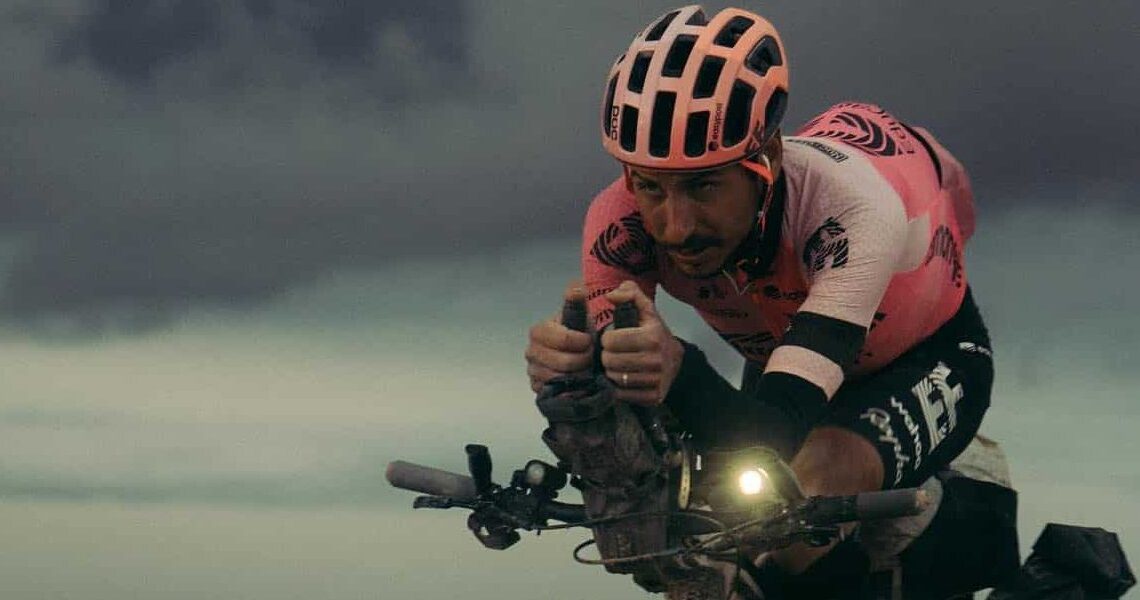
In the world of bikepacking races, arguably the biggest and most prestigious is the Tour Divide, running from Banff, Canada 4,385 km down to the US/Mexico border at Antelope Wells, New Mexico. Generally following the spine of the Continental Divide, the route takes in over 60,000 m of elevation gain. Weather and altitude are also hugely variable throughout. And of course, the big challenge with bikepacking races that distinguishes it from pro cycling is that the rider is completely self-supported, with checkpoints but no aid stations or external assistance.
In 2024, a Brigham Young University group was fortunate to systematically test a Tour Divide (TD) racer before, during, and after the race (Hyldahl et al. 2024).
- The case study focused on a 47 year old male competitor, who ultimately took 16 days, 7 h 45 min to complete the race, riding an average of 16.8 h/day and 253 km/day with 5.5 h/day sleep.
- Pre-testing occurred at 35 days pre-TD and consisted of: resting metabolic rate, MRI (for body composition), vascular function, blood sample, muscle biopsy, and a graded exercise test.
- Following the race, the participant was driven ~15 h back to Utah (with a 10 h sleep and 3 large meals). After another night’s rest, the testing was repeated, with a total time of ~36 h between TD end and the post-testing.
- During TD, the participant kept a diet log to estimate daily caloric intake. For energy expenditure, doubly-labelled water (basically an oxygen isotope that acts as a tracer) was ingested the day before TD, and urine samples were collected at days 1, 2, 4, 7, and 9.
Before and After
Take a moment to appreciate the intense exertion we’re talking about here. TD racers are not allowed to have assistance not available to all competitors. No team chefs, soigneurs, logistics planners, mechanics, or any of the support crew World Tour riders have access to. So racers have to figure out everything by themselves. And most importantly, unlike stage racing with daily stage starts and finishes, the clock never stops.

Given this and the extreme exertion, probably the biggest surprise was the overall theme of lack of major changes before and after the TD in this racer. This can be seen in the relatively minimal changes to body composition, from overall body mass and total body water down to muscle and fat mass changes. There was a slight decrease in trunk muscle mass and an increase in leg muscle mass, but fairly minor changes in fat amounts.
Maximal oxygen uptake did not change at all, staying at 59.6 mL/kg/min, nor did maximal power output. Resting energy expenditure increased from 1882 to 2011 kcal/day. Blood markers were also fairly unchanged including creatinine (often used as a marker of muscle damage), though some moved slightly beyond normal ranges.
One interesting finding during the graded test was a shift in carbohydrate and fat oxidation. Fat-max (maximal rate of fat oxidation) was lower overall and occurred at a lower percentage of VO2max post-TD. This was supported in muscle biopsy analysis of the rate of oxygen flux. Instead, there seemed to be a shift towards greater carbohydrate reliance for metabolism.
Finally, vascular function (the response of the blood vessels) was greatly reduced post-TD, which is remarkable in that maximal oxygen uptake was still maintained.

How Might We Learn From the Pros?
One outcome of this case study is another example of the remarkable ability of the human body to not just survive but to thrive even under extreme stress.
- Despite some evidence of decrements in physiological capacity, it’s interesting how ultimate performance capacity remained largely unaltered. While we don’t know how the body compensated in this case or in general, the fact that it occurred is what keeps physiologists like myself working.
- There was a strong matching of caloric intake with energy expenditure, and also maintenance of body mass and overall body composition. This is remarkable given the challenging logistics of a bikepacking race. It suggests that the body is capable of adapting as long as it’s sufficiently fueled, highlighting the importance of nutritional planning.
The biggest takeaway for all of us? Don’t be afraid to push your limits. With proper planning and training, your body can take you much further than you may think!
Ride fast and far, and have fun!
References
Hyldahl RD, Gifford JR, Davidson LE, et al (2024) Physiological assessment of a 16 day, 4385 km ultra-endurance mountain bike race: A case study. Experimental Physiology 109:165–174. https://doi.org/10.1113/EP091260
The post Tour Divide Science: What a 4,385 km Ride Reveals About the Human Body appeared first on PezCycling News.