
The racing never really stops, does it? One weekend we’re ankle-deep in frozen ruts at the ‘Cross World Championships, the next we’re juggling half a dozen early-season road races scattered across three continents. This latest AIRmail from The Outer Line, zooms out to look at what it all means—from Mathieu van der Poel and Lucinda Brand already on peak form, to an increasingly bloated race calendar, shaky team finances, and a bike industry still trying to find its footing after the COVID boom went bust. There are big wins, big questions, and more than a few warning lights flashing across the WorldTour and beyond. Consider this your guide to the results, the rumors, and the realities of the world of pro cycling right now.
Analysis, Insight, and Reflections from The Outer Line.
# Catch up on pro cycling – and its context within the broader world of sports – with AIRmail … Analysis, Insight and Reflections from The Outer Line. You can subscribe to AIRmail here, and check out The Outer Line’s extensive library of articles on the governance and economics of cycling here. #
Key Takeaways
● Cyclocross World Championships
● Road Racing Calendar Already Over-Crowded
● EF Announces “Unique Opportunity” for Additional Funding
● Did Funds From the Oscar Onley Trade Save Picnic-PostNL?
● More Bike Companies Struggle … But Some Shine
 The UCI Cyclocross World Championships concluded this weekend in Hulst, the Netherlands, and the elite Dutch men’s and women’s teams performed superlatively to a largely home crowd. The tough and technical course blended just enough “Belgian surprises” – incredibly steep and off-camber obstacles requiring dismount run-ups – to break up an otherwise fast and flowing venue. Mathieu van der Poel claimed his eighth World Championship CX title by sizing up the front runners over the first lap before surging ahead at the start of the second loop. While a spirited fight emerged behind for 2nd and 3rd (Tibor del Grosso and Thibau Nys, respectively), Van der Poel ran over the course like a truck and never looked stressed. On the women’s side, Lucinda Brand recovered from her recent drop in form and stormed back to her second World Championship win. Puck Pieterse seemed poised to take her first elite CX title and led the race early, looking the strongest of the Dutch contingent. However, Brand and Ceylin del Carmen Alvarado kept the pressure on until Pieterse made a mistake and crashed, falling back to the chasers. While the women’s road season is already underway, one can imagine that Brand, Pieterse, Alvarado, Manon Bakker, and other top riders will make an immediate impact in the spring Classics with so much sharp training already logged in a hotly contested cyclocross season. And with regards to Van der Poel – he looked sharp, raced confidently, and seemed every bit prepared for his coming road agenda.

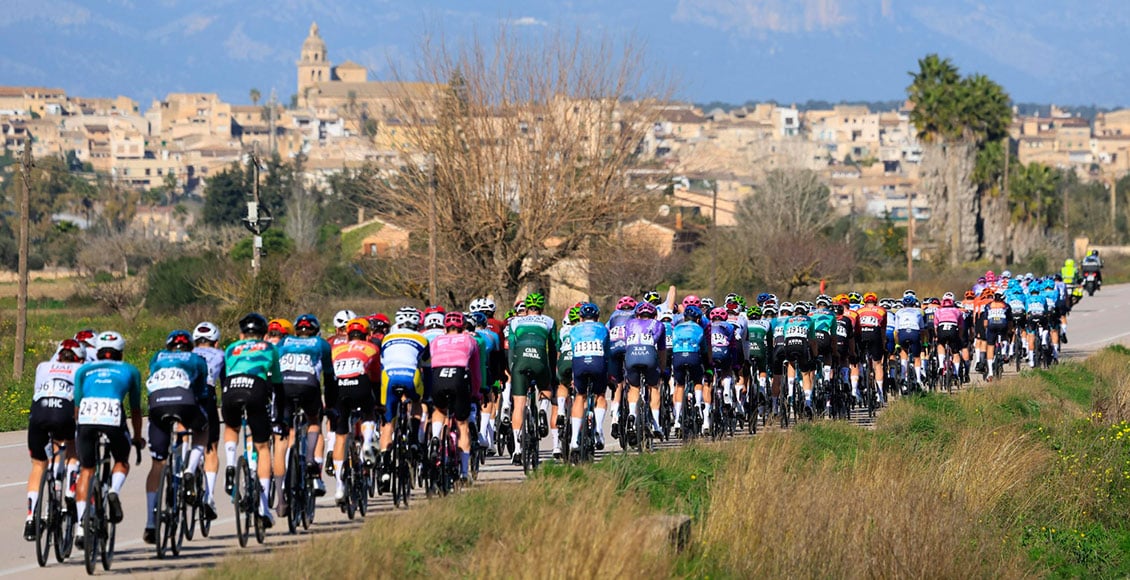
This past weekend also saw the men’s early road season continue in a now-familiar blur of overlapping and competing events. Racing has already sprawled across the calendar, from the AlUla Tour in Saudi Arabia to Challenge Mallorca in Spain, the GP La Marseillaise in France, and the Cadel Evans Great Ocean Road Race in Australia. The sheer volume is striking, but so is the way these events now overlap and compete for attention. La Marseillaise, once a clear and symbolic season opener, now goes almost unnoticed, swallowed up by an increasingly crowded January and February schedule. What is perhaps more revealing than where the races are, is who the list of riders who are not at them. Despite the packed schedule, true star appearances have been rare. Jonathan Milan has provided the headline act at AlUla, and Remco Evenepoel briefly lit up Mallorca, but those have been the exceptions. With the exception of Van der Poel (and the women’s CX world championships podium), most of the sport’s real grand tour and monument contenders are nowhere to be found, setting up a slightly awkward situation: even as early-season racing expands, top riders and teams have concluded that controlled training camps and carefully managed preparation still beat pinning on numbers for marginal February races.

In an announcement this week that was even picked up by the New York Times, Team EF Education-EasyPost said it was looking for a new lead sponsor. The team, which was acquired several years ago by travel and education company Education First, indicated that funding from the owner would continue at a steady level. However, the team said it was going to search for an additional and possible new name sponsor to attract the additional funds necessary to become the “world’s best cycling team” and to “win the Tour de France and Tour de France Femmes within the next decade.” CEO Jonathan Vaughters said while he had suggested to ownership that selling the primary naming rights for the team could provide an avenue of additional financing, he was also “flabbergasted” when the decision was actually made to create this “unique opportunity” for a potential new partner.
Team officials also asserted, without providing any back-up, that an investment in the squad could offer a new partner as much as a 5:1 financial return of investment – an incredibly optimistic appraisal given that – within the full spectrum of sports sponsorship opportunities – only a Formula 1 sponsorship even approaches this figure, sometimes providing a return estimated in the range of 2.5:1. While it is notoriously difficult to accurately measure the financial value of a sports sponsorship contract – with many highly qualitative factors that have to be turned into numbers – there is little doubt that cycling lags behind most other sports in terms of promoting its potential value. However, while the numbers are difficult to document and pro cycling’s audience and fan base may be relatively small, the costs of a team sponsorship are miniscule relative to other sports – where buy-ins can often run into hundreds of millions of dollars.
While some observers read the news as a new and different approach to funding the team, others saw it as a tacit disclosure that the team needs a lifeline to survive over the longer-term in the increasingly competitive world at the top tier of pro cycling. Also, this is not the first time the team has encountered a financial challenge; in 2017, faced with imminent sponsor withdrawals and a failed mid-season investment deal, it embarked on crowdfunding before landing the EF relationship at the last minute. It will be interesting to watch and see if any major players take up the offer that EF has laid on the table, and if so, whether it might change the playbook for other teams going forward.
Survival strategies for some UCI WorldTour teams also include cycling’s version of “Moneyball” – a calculus of talent development, roster balancing, and bartering of prized assets to remain financially afloat and somewhat competitive on the playing field. We have extensively analyzed the relationship between money and competitive success in cycling, and while there are ways that smaller-budget teams can achieve success, there is little doubt that, as a general rule, money leads to more wins. Team budgets have been steadily creeping upwards – particularly with top teams like UAE Team Emirates-XRG, INEOS and Red Bull-Bora-Hansgrohe – and most of those growing funds go into paying ever higher rider salaries. Recent examples include Ineos’s acquisition of Oscar Onley, Remco Evenepoel moving to Red Bull and Juan Ayuso’s move to Lidl-Trek – all multi-million dollar deals. Regarding Onley’s transfer from the modest Team Picnic PostNL, rumors that Onley would be on the move were well in motion before the start of the third week of last year’s Tour de France, a race in which his fourth place overall confirmed his talent and his potential market value.
More to the point – and coming around the same time Onley’s official transfer hit media inboxes – one analysis claimed that Picnic PostNL had a net loss of €6.2 million in 2025, and almost €20 million over the last three years. And nothing characterizes the intersection of debt management and insolvency like a business selling its most coveted market assets to keep the lights on. While fans are eager to see how a rider like Onley will develop in a premier program, we have to question whether the structure of the WorldTour can survive given its current salary arms race. What is the license of the team actually worth if it is the team’s roster – not the franchise and marketing value of a UCI berth – that is the only real asset in the equation? EF’s management isn’t wrong to try and solve its funding shortfall through any creative investment channel, nor is Picnic PostNL wrong to capitalize on the value of its rider pipeline. In context, both are symptoms of an unsustainable business model. The WorldTour and the UCI are eventually going to have to face up to this problem – and the recent EF and Picnic PostNL strategies only underscore the challenge. The ROI in professional cycling sponsorship has been flattening but there is always opportunity to succeed in a stressed market; innovative marketing, new sponsors, and broadcasting changes could be part of the solution.
 The Lidl-Trek team staying at the Hotel Residence Esplanade in Viareggio at the 2025 Giro d’Italia.
It was recently reported that privately-owned Trek would be making significant layoffs and restructuring moves on top of those it began executing in 2024. Coupled with the December bankruptcy announcement by leading e-bike manufacturer RadPower Bikes and recent downsizing at Canyon (more on that below), it’s been a tough stretch for the cycling industry. The Trek financial moves were detailed here , purportedly by a longstanding former Trek employee, and confirmed much of the online platform chatter that had been swirling for months about the Waterloo, WI-based brand. Like its competitors Specialized and Giant, Trek vastly over-responded to COVID-era demand and took on excessive inventory, including significant warehousing capacity. Like Specialized, it also took on significant real estate and labor risk by buying out established dealership locations to secure its sales channels. But the company is apparently in serious financial straits, even after the 2024 “adjustments.” Rumors that it may be nearing a bankruptcy restructuring or a potential sale – possibly to a private equity player – are becoming persistent as it continues to stumble over mountains of deadstock, underperforming sales, brand-recognition degradation, tariffs, and a perceived lack of corporate leadership.

And Trek is not alone; Canyon Bicycles recently announced a reduction in its overall workforce of up to 320 employees, aiming to “reduce complexity and simplify processes, as reported by Bicycle Retailer. This represents around 20% of the company’s total workforce, and amplifies the ongoing challenges faced by the bicycle industry. Roman Arnold, Canyon’s chairman said, “In cycling, you don’t win a race through sheer size, but through speed, precision, and agility. We are now laying the foundation to regain our operational power and strengthen our position at the top of the bicycle industry.” Canyon may be ahead of the curve here, especially as it is not saddled with the dealer network real estate debt and only a fraction of the warehouse inventory that Trek and many other manufacturers are apparently facing. Other brands are likely considering similar necessary cutbacks or streamlining moves, and delaying such moves could be costly as consumer sentiment in key markets continues to wane.
Even as the bike industry endures a prolonged bloodletting, there are a few notable bright spots amongst brands that know what they are, and, more importantly, what they are not. While much of the industry chased scale, complexity, and endless model proliferation, boutique brands like Colnago have quietly leaned into an older and more proven business model: make one thing and make it well. In a market where many major players appear to have boxed themselves into a corner of instability, the model of “sticking to your knitting” suddenly looks prescient and the numbers tell the story. Under the current ownership of the UAE-based Royal Group, Colnago reportedly posted roughly €14 million in profit on €55 million in revenue, an extraordinary margin by bike-industry standards. Those numbers might not seem that impressive at first glance, but when one considers that industry giant Specialized posted roughly twice that amount of profit ($45 million) in 2025 on roughly twenty times the sales volume, it illustrates just how lucrative it can be to operate effectively in a niche. Even more impressive is that just a few years prior, before Tadej Pogačar’s first Tour de France win in 2020, Colnago’s total annual revenue sat closer to €18 million, suggesting a brand that was drifting toward irrelevance. As the effectiveness of cycling sponsorship is constantly questioned, this provides a clear example of elite performance visibility, a simplified high-end sales channel, and a refusal to dilute the core product, resulting in healthy profit margins and growth.
Written and Edited by Steve Maxwell / Joe Harris / Spencer Martin
THE OUTER LINE
www.theouterline.com
@theouterline
Visit our website for our latest articles and commentary. And check out our extensive Article Library for hundreds of in-depth articles about the economics, governance, structure and competition of pro cycling, organized by subject. (Advisory Group: Peter Abraham, Luke Beatty, Brian Cookson OBE, Nicola Cranmer, Prof. Roger Pielke, Jr., Dr. Bill Apollo and Prof. Daam Van Reeth.)
The post Too Many Races, Less Money – What Kind of Year Are We In For? | The OUTER LINE appeared first on PezCycling News.