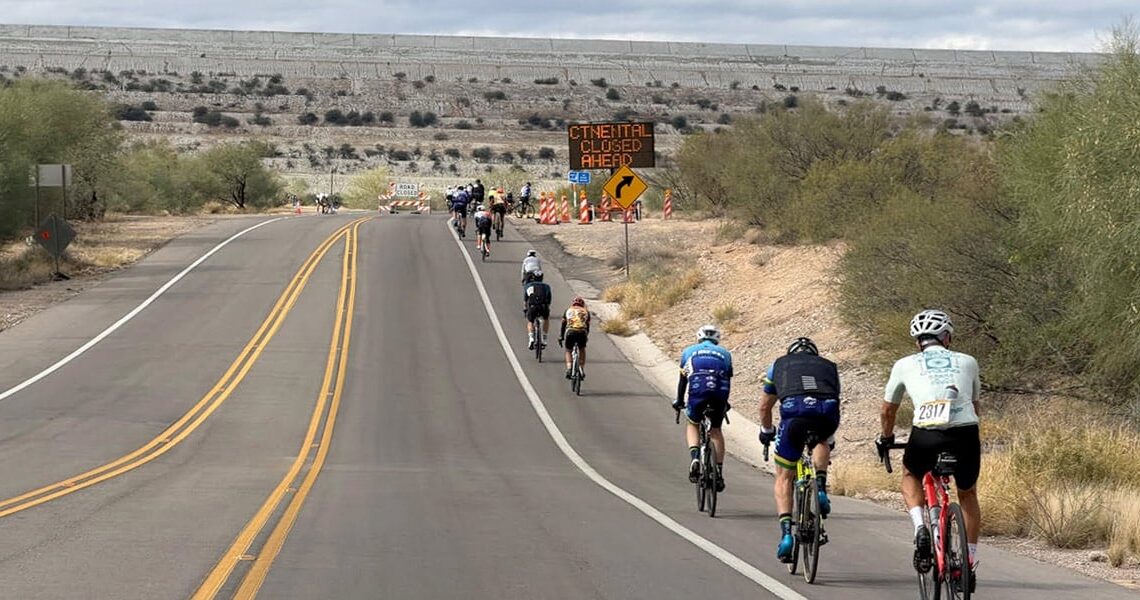

A couple of weeks ago, eTrashMike rode the star-studded Tour de Tucson for the third year in a row — and for the third time, he enjoyed the very fast ride, despite spending much of it completely frightened. His conclusion: El Tour is getting too big.
Check out the Tour de Tucson — or “El Tour” is it’s colloquially, contra-linguistically known — and you’ll learn immediately that it’s BIG.
Size is clearly a point of pride for its organizers: Virtually every webpage, every piece of collateral boasts: “nearly 10,000 participants.”
Indeed, it’s a distinguishing and appealing feature: In an era when most rides struggle for event-sustaining rider numbers, El Tour just keeps growing. (After this year’s event, watch for those boasts to read “over 11,000 participants,” as TdT registration achieved a new high water mark.)

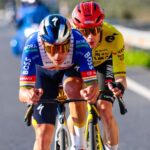
In 2023, a widely-watched GCN video spread the word about El Tour among the racing community, further spurring expansion of the Platinum division, the especially speedy slice of riders who get to start 5 minutes ahead of everyone else. (Here’s a frame from the video.)

In cycling, size begets speed: more riders generally means more fast riders; word spreads that Tucson is a fast ride — an actual race for those who wish, in fact — and the flywheel spins: In the last two years the Platinum division has more than doubled in size.

Just in front of me at the start I could spy George Hincapie (The Move jersey), Brad Wiggins (the monster in red), plus Chloe Dygert and others.
But such growth demands a strong foundation, and that’s the source of my concern: Tucson isn’t a huge town; many of its streets are broken and potholed; at some point its police force and volunteer network will stretch beyond strength.
My point: after riding El Tour three years in a row, I fear it’s getting too big.
Don’t get me wrong: the race is a blast, and riding 100 miles in less than four hours is thrilling. But at times it’s also terrifying.
Even in the Platinum tier (or maybe especially in that fast group), I noticed the fraying edges of the event’s organization: In the neutral rollout — the pre-start pedaling you see in the Tour and other elite races, mostly gently ridden amid inter-team chit-chat — riders crowded nervously around the lead car; the moment the car pulled away, signaling the official start, those nerves turned to panic as the pace exploded. At times four lanes narrowed to three, and then two; toppled cones littered our path, branches hung low over the shoulder, further narrowing the route — and at one point we swung right, heading east, directly into the sun, and we were drafting largely by sound and feel — at 30 mph.
 Thousands of riders gathered behind our “Platinum” group.
I heard a few crashes around me, but pressed on, until two riders went down maybe 20 blind meters in front of me; I braked hard, and swerved right, and bumped a curb, and by the time I could right myself and return to speed, the lead group was 50 meters up the road — aka a light year when you’re a solo rider chasing a pack of 100, led by some of several elite professionals.
I reeled in a few other stragglers, and we were swallowed by a larger group, and soon I was riding with a diverse tranche of 80 or so — diverse because the group was comprised of elite riders who had tumbled, or had been detained by crashes, plus dozens who simply hadn’t been able to keep up. Over the century’s few gentle climbs, and through the day’s brisk crosswinds, this group struggled to maintain anything like momentum: We were fractured, and frenetic, and I was frustrated. I rode towards the front, encouraging cooperation, hoping to draw in more riders shelled from the front group, and still to crack four hours, but far from a tight paceline, our group was a hive of shifting, frenetic, short-lived efforts.
Exasperated, about sixty miles in a couple of my chase-mates and I shifted our strategy from cooperation to self-concern, and swung our lead from the windward side of the road to the downwind edge, shrinking our lee and essentially punishing anyone who wouldn’t ride towards the front — putting them in the gutter, in racing parlance. The move had its desired effect, as after a few minutes of riding the road’s edge I looked back and saw that our group of roughly eighty was now just eight; our drastically diminished crew would ride together to the finish, collecting spent riders as we pushed on.

When I took time to look around, the views were stunning.
Even in a smaller group like ours, El Tour’s last 10 miles, a straight, downwind assault on downtown Tucson along fissured roads and through intersections where police officers held traffic, were again terrifying; every red light we barreled towards appeared suspect, with cars threatening to edge into our path, notwithstanding those officers’ half-hearted arm-waves. I dodged potholes, as well as the rear wheel of a fellow rider who, exhausted, veered in front of me, trying to collect the draft of a car passing in the parallel lane. When we blew through the final, closed city blocks and I spied the finish line and the race clock, I was more relieved to have survived than disappointed to have missed the four-hour mark.*
So: sour grapes? Sure: with a smaller field, I’d have been less likely to get stuck behind a crash, the echoes in my head of Phil Liggett tut-tutting my not being at the front notwithstanding; I’d hoped to ride at least to the first hill with the likes of George Hincapie and Bobby Julich (Brad Wiggins having been dropped early). But beyond my selfish aspirations, the Tour de Tucson feels on the verge of gaining a reputation not for volume and speed, but peril, and then that flywheel could reverse direction: This year WorldTour pros Quinn Simmons and Tucson native Matthew Riccitello, both of whom I’d seen near the front in 2023 and 2024, respectively soft-pedaled, avoiding risk — and in Riccitello’s case, decided not to ride at all.
So to the Tour de Tucson organizers, I say: pump your brakes on the growth. Cap overall participation, and beef up the requirements on the Platinum level. Nudge registration fees up to do right by your benefiting non-profits. And…start 15 minutes later, so by the time your feverishly-paced Platinum group turns east, the sun isn’t at eye level.
Your ride/race is regarded for size and speed, but if you don’t slow your roll, TdT, you’ll be better known for danger and disorder.
After all, sometimes, bigger isn’t better.
*El Tour is actually 102 miles; our time of 4:03 put us just under four hours for a century.
The post The Tour de Tucson is Big. TOO Big? appeared first on PezCycling News.