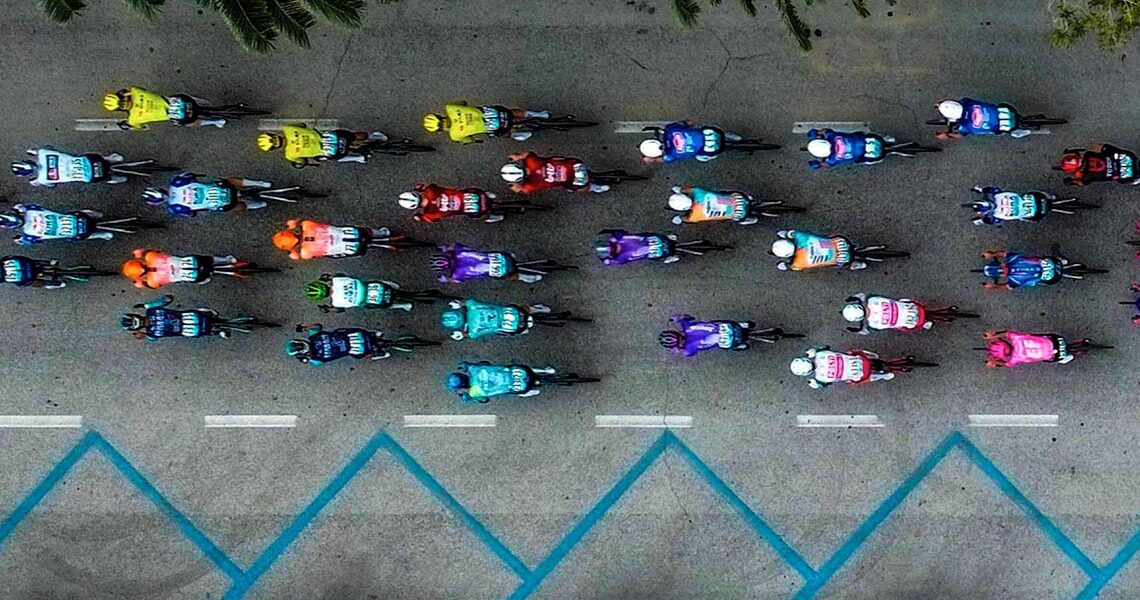

The WorldTour’s most chaotic week delivered exactly what we’ve come to expect from cycling’s split personality: brilliance, imbalance, and just a hint of absurdity. With Paris–Nice and Tirreno–Adriatico once again running head-to-head, fans were treated to a non-stop stream of racing—but not necessarily best-on-best competition. Jonas Vingegaard obliterated the field in France with a historic margin, while rising star Isaac del Toro finally won an Italian stage race. Add in extreme weather, rider protests, tactical oddities, and the ever-growing question of whether cycling’s calendar is working against itself, and there’s much to read about in this week’s AIRmail from The Outer Line.
Analysis, Insight, and Reflections from The Outer Line.
# Catch up on pro cycling – and its context within the broader world of sports – with AIRmail … Analysis, Insight and Reflections from The Outer Line. You can subscribe to AIRmail here, and check out The Outer Line’s extensive library of articles on the governance and economics of cycling here. #
Key Takeaways:
● Another Crowded Week in Pro Cycling
● Vingegaard Blows Away Field at Paris-Nice …
● … While Del Toro Takes Second Stage Race of the Year at T-A
● The Women Race at Trofeo Alfredo Binda
● Exercise and Brain Health
● The Safety of Sporting Events

The overlap between ASO’s “Race to the Sun” in France, Paris–Nice, and RCS Sport’s Italian showcase in Italy, Tirreno–Adriatico, remains one of the more curious traditions in professional cycling. The scheduling intersection has endured for decades, rooted in the longstanding commercial rivalry between the sport’s two biggest race organizers who run parallel stage races for the same top-level riders at the same time. The talent and race drama balances evenly across the two events in some years, while other times one race clearly outshines the other – like this year. The simultaneous racing creates one of the most entertaining weeks of the season, offering near-continuous action across two very different landscapes as the sport transitions toward the Classics. While this may delight some superfans, it is also one of the most glaring examples of cycling’s tendency to overcrowd the calendar – creating an unnecessary overkill that dilutes both events and forces teams, athletes and fans to choose. Perhaps underscoring just how destructive this dilution of talent can be …. over the last five years, the sport’s top two GC teams, Visma and UAE, have won every edition of both races. The fact remains that in a modern sporting landscape, it is difficult, if not impossible, to convince casual viewers to watch two separate events, neither of which feature best-on-best competition. Imagine if there were two competing Formula 1 events on the same weekend; which one would you watch?

Pro cycling sits on a low simmer as it awaits its spring “clash of the titans” starting with Milan-San Remo this weekend, and last weekend delivered two very different portraits of modern stage racing. At Paris-Nice, Visma-Lease a Bike’s Jonas Vingegaard put a quick end to any speculation that the wave of young talent would knock him off his perch. The second-best GC rider in the world secured a dominant victory by over four minutes ahead of second-place Dani Martinez – the largest margin of victory in the race’s modern history; he also took two impressive stage wins. However, the race itself never quite found its rhythm, after brutal weather conditions knocked out many of the top GC contenders, including Lidl-Trek’s Juan Ayuso on Stage 4, and reshaped the final weekend. Crosswinds, cold rain, and the decision to dramatically shorten Saturday’s Stage 7 gutted what was supposed to be one of the race’s decisive mountain tests. And even with the race distance taken down to just 47 kilometers, there was plenty of controversy between ASO, the race organizer, and the riders, with the stage going ahead despite 60% of the riders voting to cancel the race. There were concerns that the team buses wouldn’t be able to make it through the valleys in the mountains behind Nice, leaving the riders stranded in Isola with no shelter or exit plan. Still, the final day delivered at least one jolt of excitement, with French climber Lenny Martinez edging out Vingegaard to take an impressive stage victory on the streets of Nice.

Meanwhile, over at Tirreno–Adriatico, the results were more revealing, with UAE’s 22-year-old Isaac del Toro rapidly ascending into cycling’s top GC tier as he claimed the overall win. It was Del Toro’s second WorldTour stage race victory of the year and the first “Big 7” one-week race of his career (notably, something Remco Evenepoel has yet to accomplish). Behind him, American Matteo Jorgenson rode superbly to claim second place overall, opportunistically grabbing time bonuses on the final day to leapfrog Giulio Pellizzari. Meanwhile, Mathieu van der Poel turned the race into a surreal training ground for Saturday’s Milan–San Remo by performing a 30-kilometer interval session at the front of the peloton, shelling nearly everyone and even dropping his own teammate Jasper Philipsen at one point. The spectacle was both thrilling and slightly absurd – a reminder of the increasingly specialized way top riders approach the calendar and ride themselves into fitness. It also highlights the massive importance placed on the top events, at the expense of the other riders – and adds further evidence to the argument that the UCI’s WorldTour calendar needs serious thinning and reworking. And hovering over it all was the ongoing Paul Seixas mania, even as the teenage French sensation sat out both races. The rumors surrounding the bidding war for his future contract only intensified, indicating that cycling’s next generation is starting to reshape the sport, before many of its other hopeful stars of the future have even reached their prime.
 Mathieu van der Poel drilling it at Tirreno in prep for San Remo
The Women’s WorldTour was also active over the weekend, at the Trofeo Alfredo Binda – although much of the cycling world may have missed it as the men’s double feature hogged most of the broadcasting airtime. In another bright spot for the broader UAE team, Karlijn Swinkels of the Netherlands held off compatriot Anna van der Breggen of SD Worx and Norwegian Mie Ottestad of UNO-X in a three-up sprint for the finish. As was the case at Paris-Nice, the race may have lost some of its character when a prominent early climb was eliminated due to snow. However, the shorter overall length may have made the day tougher due to constant attacks and tactical pressure. Van der Breggen may have lost the sprint but spiritually won the day, showing the peloton that she is nearly back to full strength after her short retirement, and that she may be the foil to Demi Vollering in the upcoming women’s Monuments.
 Karlijn Swinkels leads the champagne shower
Women’s sports more generally have been in the vanguard so far in 2026, alternately setting the tone for investment shifts, fan demand, or athlete rights – and all three happened over the last week. The ongoing labor dispute between the players and the WNBA heated up as both sides met without resolution over earnings and profit sharing, among other power issues as two expansion teams ready to join the league. The fact that the players are willing and able to exercise a strike to force concessions should not be lost on anyone following women’s sports – and sports in general – and it shows a new level of power and solidarity. On the other hand, fan demand and spending is driving that leverage, especially in light of record setting opening day attendance at various NWSL matches; the Boston Legacy pulled over 30,000 new fans into its opener, while the Denver Summit have already sold more than 50,000 tickets to their opener coming up on March 28. This trend of increasing investment into women’s sports should be an impetus for the UCI to continue to look at its options for supporting the WWT as it reaches a critical juncture for sustainability and growth.
A report last week suggested that short bursts of exercise can be a boost to brain activity. A measure of brain health and cell growth – BDNF – spiked in a test group when measured after short bursts of exercise like cycling. These increased BDNF levels were linked to improvements in focus and attention. According to the study’s lead author, “the most exciting finding from our study is that if we become fitter, our brains benefit even more from a single session of exercise, and this can change in only six weeks.” And, for the “seniors” in our audience, another study showed that people over 65 can show consistent and measurable improvement in their brain health and function as well as physical fitness as they continue to age. Most interestingly, this report indicated that a “positive mindset increases the likelihood of healthy aging.” It’s all in your head.
 Oscar Sevilla at La Vualta c. 2001
The entire Medellin-EPM team of 49-year-old Oscar Sevilla, was banned from racing for thirty days, after two riders triggered athlete biological passport violations. According to the ITA, which now administers that program, both ldemar Reyes Ortega and Fabio Andrés Duarte were notified sometime last year of abnormalities in their profiles. The rules state that any time that two or more riders or staff are cited for anti-doping rules that an automatic suspension kicks in.
The volatile situation in the Middle East due to military action centered on Iran has spilled over to the UAE, with detrimental geopolitical and global economic impacts unfolding day by day. Iran has launched nearly 2000 ballistic missiles and drones at UAE targets since the conflict erupted, with several strikes on Monday hitting Dubai Airport – temporarily shutting it and Emirates Air down – and setting critical oil infrastructure ablaze at Fujairah, one of the region’s most important petroleum relays at the mouth of the Hormuz Strait. Analysts have noted that Iran’s bid to shut down shipping through the Strait must also include alternative oil export points like nearby Fujairah in order to achieve the aim of choking off global energy supplies. More immediately, the attacks have destabilized UAE’s national image as a safe haven for the global elite. Thousands have sought to flee the strife – taking their money with them in a kind of “money exodus” – while UAE investments committed as part of its global and regional diversification are collapsing. A key question is whether this may eventually affect other UAE investments, such as those in the eponymous WT-leading cycling team – as well as a wide variety of other sporting ventures.
Buried beneath other, far more important global drama and strife headlines over the last two weeks, the U.S. congressional funding impasse dragged on with significant impact for the 2026 FIFA World Cup. Preparations for soccer’s marquee global event, to be hosted across North America – with the most important matches on U.S. soil – are dependent on massive investments in venue and regional security. The current delay in releasing necessary funding means that FEMA – the agency tasked with allocating $625 million appropriated specifically to bolster World Cup security – raises worrisome questions. It was reported that 11 cities were earmarked $250 million of that allocation specifically for police drones and related infrastructure alone. While all of this raises broader questions about U.S. host city preparedness (or what 11 cities will do with $250M in drones after the World Cup), it also provides insight into the true cost of hosting a global sporting summit in which public space, influx and movement of millions and fans, and public tax dollars and private stadium interests intersect.
The situation has strong similarities to the security needed for an event like the Tour de France. One key difference we’ve examined in prior articles (and that was discussed in Le Fric – Alex Duff’s authoritative book on Tour organizer ASO and the Amaury family) is the fact that the French government formally and informally provides ASO with gifts, discounts or subsidies for the use of public resources in staging the country’s iconic annual sporting drama. But that true cost, if solely borne by ASO and the race’s sponsors, would likely consume much or all of the race’s profits. A similar, but perhaps not as pervasive subsidy model is leveraged by a variety of other bike races, such as the Giro d’Italia. However, it is not available to races like Amstel Gold – an event which has been heavily financially impacted by public security and police course marshalling costs in recent editions. Given the number of high-profile and security-related infractions in cycling which have happened in recent years – including protests directed at the former Israel-Premier Tech team at last year’s Vuelta a Espana – security will continue to be a critical challenge for race organizers, teams and riders who have too often found themselves in harm’s way. And given the ongoing Gulf conflict we mentioned above, that factor may come into play by next January, but hopefully be resolved by the time Dubai hosts the UCI World Championships in 2028.
Written and Edited by Steve Maxwell / Joe Harris / Spencer Martin
THE OUTER LINE
www.theouterline.com
@theouterline
Visit our website for our latest articles and commentary. And check out our extensive Article Library for hundreds of in-depth articles about the economics, governance, structure and competition of pro cycling, organized by subject. (Advisory Group: Peter Abraham, Luke Beatty, Brian Cookson OBE, Nicola Cranmer, Prof. Roger Pielke, Jr., Dr. Bill Apollo and Prof. Daam Van Reeth.)
The post The Outer Line: Paris–Nice vs Tirreno Chaos: Vingegaard Dominates, Del Toro Rises & World Cup Security appeared first on PezCycling News.