
If there’s one contact point that can make—or break—your ride, it’s the saddle. Enter the CADEX Amp 3D Saddle, a short-nose perch that blends ultralight carbon construction with cutting-edge 3D-printed gyroid padding to chase the holy trinity of cycling performance: comfort, efficiency, and power transfer.
CADEX Amp 3D Saddle—$450.00

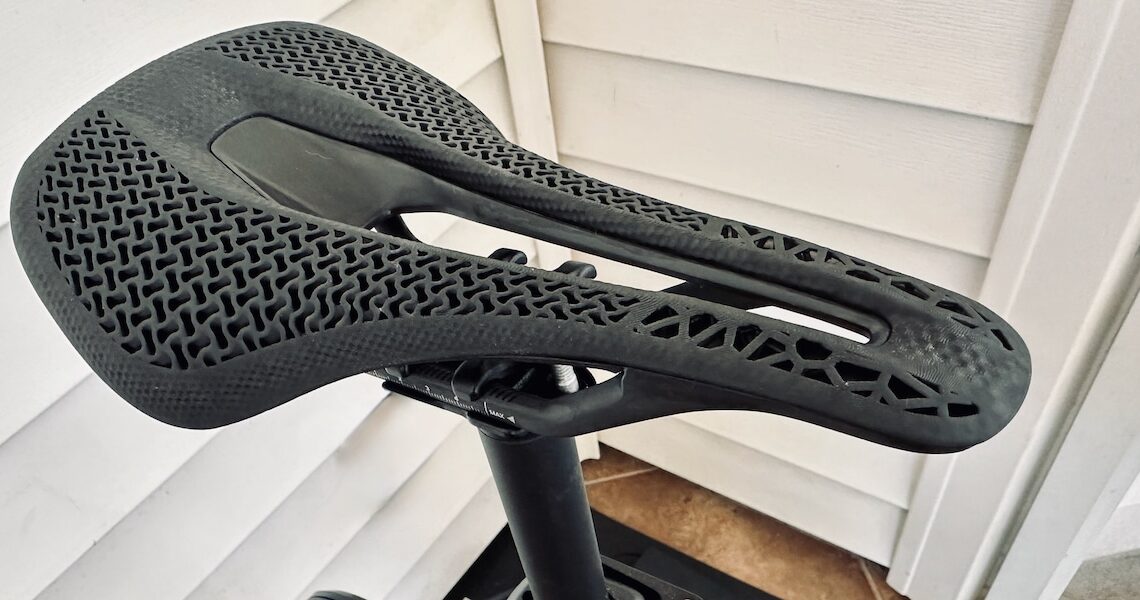
Built around CADEX’s Advanced Forged Composite Technology (AFCT) base and rails, and tipped at a claimed 147 grams (mine was a hair over at +3g), the Amp 3D uses precision-tuned G3D infill to vary density across key pressure zones—firmer through the center, more forgiving at the nose and rear—to reduce hot spots and smooth road buzz. At 245mm long and 145mm wide, with a generous center cut-out and curved profile, it’s designed for aggressive aero positions and long hours in the saddle, whether you’re hammering outdoors or logging steady watts indoors. The question isn’t whether 3D printing looks cool— you can make up your own mind —but whether the $100 premium over the standard Amp delivers real-world gains in comfort and performance.
Per CADEX:
The Amp 3D saddle combines cutting-edge 3D-printed G3D gyroid infill with an ultralight carbon base for unmatched comfort, efficiency, and performance. Its precision-tuned structure optimizes pressure distribution, minimizes weight, and absorbs road vibrations for a smoother ride. Designed for maximum power transfer and durability, the Amp 3D delivers the perfect balance of support and speed.
- Exclusive Gyroid Structure: High-resilience EPU 3D-printed padding integrates a cutting-edge gyroid design, delivering superior pressure distribution, enhanced support, and maximum comfort at minimal weight.
- Precision-Tuned G3D Padding: 3D-printed gyroid infill padding allows precise variation in density across the center of the saddle, optimizing support and comfort in key pressure zones while keeping weight to a minimum.
- Optimized Performance Shaping: A crowned profile that quickly drops away at the wings increases pedaling space, improving fit options and reducing clearance issues.
- Smooth-Edge, Truncated Nose: Minimizes inner thigh interference for unrestricted pedaling motion.
- Advanced Forged Composite Technology Base: A low-seated, SMC carbon base eliminates flex, enhances support, and maximizes pedaling efficiency.
- Integrated Rail Design: Relieves pressure points while improving compliance for a smoother ride.
- Ergonomic Center Cut-Out: Reduces pressure on soft tissue areas for long-lasting comfort.
Amp 3D key specs:
- Width: 145mm
- Length: 245mm
- Stack Height: 41mm
- Weight: 147g
- Rail Material: Carbon
- Rail Size: 9.5mm
- Shell: Advanced Forged Composite Technology (AFCT)
- Padding: G3D Gyroid & Lattice Structure

My Amp 3D was 3 grams heavier than spec
Chuck sez: PEZ readers may remember my review of the CADEX Amp saddle. As the name implies, the Amp 3D saddle is the same saddle but with 3D printed padding instead of traditional foam padding. Going 3D comes at a price. The Amp 3D costs $100 more than the “regular” Amp saddle.
Design-wise, the Amp 3D is the same as the regular Amp saddle:
- It’s a short-nose saddle (245 mm — the UCI limit is 240 mm)
- Curved shape
- An ample center cutout to help reduce pressure on the important bits
- It only comes in one width: 145 mm

The carbon fiber base and rails are also the same as the regular Amp saddle. They are made via Advanced Forged Composite Technology. Most carbon fiber composites are made with continuous layers that are “laid up.” Forged composite is composed of small pieces of carbon fiber that are pressed into shape as the resin cures. This process allows for a wider range of shapes (such as thickness transitions and compound curvature) to be formed with precision relative to traditional carbon fiber.
One thing to know is that forged carbon fiber isn’t as strong as woven or unidirectional (UD) carbon fiber (the latter being the strongest). That doesn’t mean the forged composite rails on the CADEX Amp are weak — just not as strong as woven or UD. If that creates some concern, CADEX has what it calls a Composite Confidence support plan (in addition to CADEX’s warranty and service policies):
We’re so confident in CADEX’s composite technology, if any composite component is structurally damaged while you’re riding in the first two years after you bought it, we’ll repair it or replace it free of charge.
Just keep in mind that “it only covers damage done while riding, so don’t go driving into your garage with your bike on top of your car. That’s on you.”

Curved saddle profile
Is it for you?
Is the Amp 3D saddle for you? That’s a question I can’t answer definitively because saddle choice is very personal. What’s comfortable for one person can be a total PITA (quite literally) for another. So YMMV and your decision will be based on a variety of factors, including:
- Your anatomy (particularly sit bone width)
- Your flexibility
- Your position on your bike
- Your riding style

Ample cutout for undercarriage comfort is really a channel that runs the full length of the saddle
What I can say is that I’m a fan of short-nose saddles like the Amp 3D that offer these potential benefits:
- They allow you to lean forward more and get lower into the aero position more comfortably by reducing pressure on soft tissue
- The nose of the saddle is usually wider than traditional saddles, providing more of a platform for sitting when the rider wants to ride “on the rivet”
- Short-nose saddle design is supposed to encourage riding in a more fixed position, offering better stability and better weight distribution, because you’re not moving around as much
- A short-nose saddle provides increased clearance for the quads and hamstrings because there’s less saddle to get in the way

100 percent black carbon fiber goodness
And my butt is a fan of the curved design (both front-to-back and side-to-side) of the Amp 3D saddle. Curiously, because my back is still pretty flexible for my advanced years (I can touch my toes, which is part of my regular stretching routine), most manufacturers would recommend a flat saddle shape for me. But I’ve test ridden flat saddles and they’re completely uncomfortable for me. One of the reasons why it’s so important to test ride saddles and not necessarily go entirely by a manufacturer’s recommendation.

My ride experience
Given that I found the regular Amp saddle a comfortable ride, I had no reason to believe I wouldn’t have the same experience with Amp 3D saddle. But I put the Amp 3D saddle to a slightly different test. Instead of riding it on one of my road bikes (either my Colnago V3 or LOOK 795 Blade), I put it on my KICKR BIKE PRO. In many ways, I think doing so is actually a more “rigorous” test because riding on Zwift or ROUVY is largely a seated affair. You’re pretty much firmly planted and “fixed” on the saddle for the duration. And there isn’t any natural bike movement, which can be a comfort factor. So any uncomfortableness is going to make itself more apparent (and sooner). I’m happy to report that the Amp 3D saddle has been comfortable for me on 2+ hour indoor training rides.
I also experienced #marginalgains comfort from the Amp 3D’s 145 mm width. Like the Amp saddle, the back end of the Amp 3D saddle is more T-shaped than Y-shaped. It’s probably not as noticeable riding IRL, but sitting up to take a swig out of my water bottle or towel off sweat on indoor rides I could feel and appreciated the extra real estate to park my butt.

Is it worth going 3D?
But I’m sure the question PEZ readers have is whether the $100 premium to go 3D is worth it? What the 3D printed padding provides is the ability to more precisely dial in the firmness/density of the padding in different parts of the saddle to better distribute/relieve pressure. I have no way to objectively test/measure, but just using my thumbs for tactile feedback:
- The back third or so of the saddle was more on the “soft” side
- The middle third or so felt the firmest
- And the nose felt softest (the printing pattern is also more “open”)

Whether this means that the Amp 3D saddle will be more comfortable than the regular Amp saddle (or any other traditional padded saddle), I can’t say definitively because it’s subjective and specific to each rider. What I can say is the the Amp 3D saddle is a “different” kind of comfortable for me:
- I felt like I was more sitting “on top” of the Amp 3D saddle rather than “in” it (my experience with other 3D printed saddles is similar).
- Also similar to other 3D printed saddles I’ve ridden, the “padding” feels firmer that the foam padding of traditional saddles.
- As a result, I also felt like I was more “in contact” with the saddle. I could definitely feel the saddle under me, but no pressure points (if you’ve ever sat on the wooden beads seat covers that a lot of taxi drivers use — and that I have on my computer chair — that’s a good analogue).
- It’s worth noting that the 3D printed material can be a little “grippy,” which helps keep you positioned on the saddle. Although not quite as smooth as a traditional saddle cover, I could still move around on the saddle easily enough.
Finally, there’s this: IMHO the 3D printing just looks cool.
My bottom line
3D saddles aren’t “common,” but there are now more choices than when they first came to market. But I don’t think anyone should go 3D simply for the sake of 3D. As I’ve said before when it comes to saddles:
If you’re 100% happy with your current saddle (not experiencing any discomfort or saddle sores), I’m not going to recommend you switch saddles (from any manufacturer at any price point) — 3D printed or otherwise. Especially when it comes to saddles, never ever try to fix what ain’t broken.
But as someone who got on well with the regular Amp saddle, IMHO the Amp 3D takes it up a notch. At least for me, it’s even more comfortable. So if you’re in the market for a new saddle and have the $$$ to see (or more correctly, feel) what 3D is all about, the CADEX Amp 3D saddle should be on your radar.
The post Review: CADEX Amp 3D Saddle – Performance Amplified appeared first on PezCycling News.