
I have an autographed World Champion Rainbow Jersey signed by Peter Sagan and moving it around today I reflected on the nature of fame. I was present in 2015 in Richmond, Virginia when Sagan won the race that year. This was the first of three successive victories at the Worlds for the Slovak but since then there have already been six other male riders who have taken the Rainbow Jersey. Most of us can easily identify them but what happens when we go backwards over the decades? Do we remember Romans Veinstains, winner in 2000 in Plouay? Or Heinz Muller, who won in Luxembourg in 1952? Or the youngest World Champion ever–Karel Kaers, who won in Leipzig in 1934?

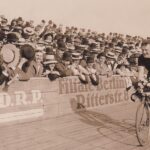
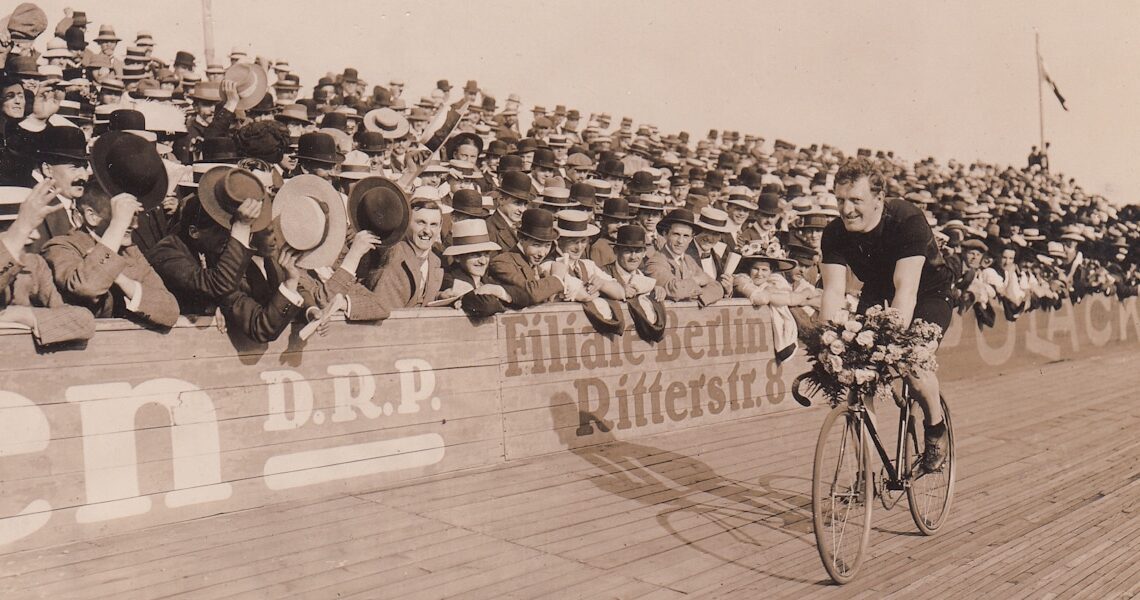
Rutt riding past crowd
Many World Champions have remained familiar because of their entire palmares–but even that is not enough as riders, once great, vanish into the fog of time. We have written here about Teddy Richter, World Amateur Sprint Champion in 1932. He was almost certainly murdered by the Nazis, who then tried to erase his achievements from the record books. We have recently come across the story of another German track racer who would probably be entirely forgotten now but for the efforts of a single cycling fan and the potential of the Internet.
Walter Rutt was born in Wurselen, Germany, close to Aachen, in 1883. A talented rider, the Rhinelander turned professional at the age of 17 and went on to a remarkable career that spanned an incredible 25 years. In that time he won some 933 races, including the Six Days of New York three times and the Berlin Six Days four times, as well as being crowned the best sprinter at the UCI World Track Cycling Championships in 1913.

Time out for food at the Six Day Races
A great athlete, his competitiveness and friendly demeanour earned him many fans. He was a capable linguist as well, being fluent in English, French and Danish as well as his native German.

John Stol and Walter Rutt in Newark, 1912
He raced as far afield as Australia, in addition to the United States and throughout Western Europe, meeting up with the elite riders of the age. By 1904 he was considered to be the best sprinter in the world but his subsequent career in the brutally hard endurance events of the era showed his true quality.

Lining up for a sprint race, 1904
One assumes World War I would have put pause to his racing as he became a non-commissioned officer in the German Army, acting as an instructor for motorcyclists. In fact, he continued his racing, with great success, in spite of the conflict as races in Germany were still being held. Following the war he still raced primarily in Germany but returned to New York for the Six Days there in 1921 and was met with a great reception. It is remarkable to think that his last big victory, the Berlin Six Days in 1925 with a Belgian partner, Emile Aerts, was when he was 42. He finally retired from racing shortly afterwards.

Like jockeys, sprinters were identified by their racing colours. Here is Walter Rutt’s Jersey and cap (Stuttgart University Archive)
In spite of his popularity and evident affability, life after racing was to prove more of a challenge. Having earned considerable money during his career, his subsequent ventures into business were disastrous and he was destitute by 1937. At this point he was able to obtain a coaching position under the Nazis, who had brought cycling and all other sports, along with every other aspect of life in Germany, under their totalitarian grip.
Walter Rutt survived the war and the difficult years immediately afterwards in Berlin. A very strange but at least positive moment for him came in 1953, when the UCI sent him a parcel from France shortly before his 70th birthday. It contained the certificate confirming his world title they had forgotten to give him at the victory ceremony in 1913 in Leipzig. Clearly somebody had been rummaging around at UCI HQ and found it forty years later…but, well, better late than never one supposes.
The old racer kept fit and wrote about his past exploits for German cycling publications. His subjects included training, tactics and healthy living. He received a Berlin city honour to mark his 70th birthday. The old man must have had enormous pleasure from being a guest of honour, along with his old teammate John Stol, at the 50th Berlin Six Day Race in 1962. Walter Rutt passed away two years later, aged 80. His funeral was attended by only a few close friend and his grave became overgrown and forgotten with time.

The ‘Old Champion’
Pro Cycling Stats has nothing on this former World Champion and Wikipedia has only the briefest of entries. How is it then that we are able to know even this much as set out above about a rider who retired in 1925? This takes us to the efforts of one person to bring the story of Walter Rutt back to life.
In 1977, young Bernd Wagner, living not far from Munster in the western German state of North Rhine-Westphalia, was enthralled, as were many of his countrymen, by the exploits of Dietrich “Didi” Thurau. In that year’s Tour de France, Thurau won the Prologue and four stages, as well as wearing the Yellow Jersey as race leader until Stage 15. Inspired, Bernd Wagner bought a bicycle and began racing. In 1985 he was a founder of the local cycling club in Coesfeld and was the announcer at the Coesfeld City Bicycle Race for a decade.
Besides getting that bicycle in 1977, he also bought a book on the history of racing. This included biographies and photos of notable racers. While most of them had two pages dedicated, only a single rider got four. This cyclist was Walter Rutt. Herr Wagner was so fascinated by this he began to research Rutt’s life and collect memorabilia related to him. This collection has grown to a considerable size.
As someone wanting to share his enthusiasm, Herr Wagner needed to find a way to spread the story. Although he had done intensive research over the years, there was a long gap in Rutt’s life story that would be too limiting for a book, nor would it make much financial sense. Turning to new technology, in 2000 he launched a website devoted to Rutt and over the years this labour of love has showcased his research and items from a collection that would fascinate anyone with an interest in the early days of bike racing. Looking through the “Collectibles” section of the website brings a whole era back to life.
Not content with this, Herr Wagner did two things which any researcher and collector would be proud to have done. He learned in 1998 that Walter Rutt’s grave (along with that of his wife and sister-in-law) would be leveled as there is a defined “right of use” period and this would expire in 2003. He submitted an application to the Berlin Senate for the plot to be named as a “Grave of Honour,” and this was duly done in 2001. This has meant that plants have been added and the District of Steglitz-Zehlendorf will be responsible for its ongoing maintenance.
In 1999 Herr Wagner wrote to city officials in Wurselen, the birthplace of Walter Rutt, suggesting that they might want to honour this World Champion in some way, perhaps by naming a street after him. This idea was taken up with great enthusiasm as in nearby Morsbach a new sports hall had just been built and had yet to be named. So now, thanks to the efforts of this cycling fan, unrelated to either Walter Rutt or Wurselen in any way, the name of this great athlete appears on the Walter-Rutt-Hall today. At the dedication ceremony in 2001, Herr Wagner provided material from his collection for a small exhibition in the foyer. He also made the keynote speech that day.
Herr Wagner has even been in contact with the descendants of the racer. Rutt’s first wife (he seems to have been married three times) was Danish and after their divorce she returned to Denmark with their two sons, Oskar and Orla. Oskar had a career as a track racer at one point but passed away in 1952, while the younger son only died in 2004, aged 89. One senses Herr Wagner’s disappointment that he was unaware of this when the Walter-Rutt-Hall was dedicated as the presence of Rutt’s son would have added so much more to the event. Rutt’s grandson in Denmark was able to learn about all of this after finding Herr Wagner’s Walter Rutt website.

The Walter Rutt Hall
Why should you look at a website devoted to a German track racer whose greatest feats took place before World War I? We forget that bicycle racing was not always the niche sport we see it as today. Track racing was huge all around the world and the athletes, international stars and handsomely paid, attracted public notice and adoration to a level that seems remarkable now.
Furthermore, Herr Wagner’s website is a fine example of how someone can turn a hobby into a beautiful tribute to a bygone era. His pages on the Internet tell the story of Walter Rutt, his sporting accomplishments and later life. There are many examples under the “Collectibles” section that shine a light on the world of track racing c. 1905-1925. A great deal of effort has gone into the website over the last two decades, most recently in producing a version of it for an English-speaking audience.
Herr Wagner has nothing to sell except Walter Rutt’s life story, and a willingness to share what he has learned in his research and his pleasure in making a collection. In the words of Cicero, “Memory is the treasury and guardian of all things” and here we see how the efforts of one person can keep that memory alive around the world
So check it out HERE! It is terrific stuff.
(Annoying pedantic note: the cyclist’s name in German is Walter Rütt, not Rutt. Sometimes in an English text “ue” would substitute for “ü” but diacritical marks from foreign languages are often dropped entirely in English writing. We have used this approach here as the English version of the Rutt website does this.)
The post PEZ Pedals Backwards: Walter Rutt, World Champion appeared first on PezCycling News.