
Those of us interested in the history of cycling technology are well aware that so many manufacturers that were once giants have departed the field of competition. Once-global enterprises like Raleigh, that may exist only as a label today, or notable high-end boutique framebuilders like Flandria, Frejus, Cilo, or Rickert, have faded away, joining the ghosts of component manufacturers Simplex, Huret, Zeus and Galli.

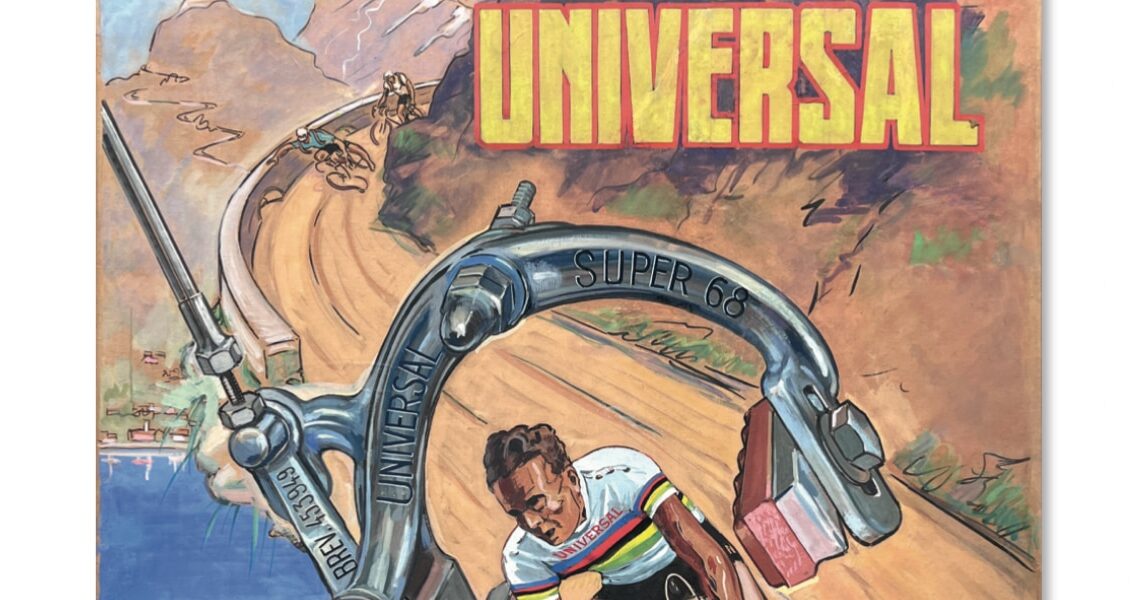
An interesting new book released this week tells the story of Italy’s Universal, manufacturer of bicycle brakes in Milan. This was a company that was indeed once “universal” in that its products were the choice of champions for the better part of four decades. As noted by Ernesto Colnago, interviewed for the book, “Once upon a time when you said Universal, you meant brakes.”

The Pietra Brothers, Eugenio and Carlo, established a small machine shop on the outskirts of Milan in 1919, and began producing molds and small metal parts. Within three years they were stamping out the first bicycle brakes acting as subcontractors. Not limited to this product, in 1930 they presented some impressive pedal cars modeled on the Alfa-Romeos produced in the nearby automobile factory. In 1931 came their first in-house bicycle brake, the Model 31, and the company name changed from Fratelli Pietra to Freni Universal.

The quality of the brakes was of the highest level and those who used them were a Who’s Who of professional cycling, with surnames including Olmo, Coppi, Bartali, Nencini, Bobet and Motta. Framebuilders specified the Pietra components for their customers–they appeared on Bianchis, Masis, Legnanos and Colnagos. The company, which always remained a family enterprise for its existence, even was sponsor of a local club racing team, Azzini-Freni Universal, that even participated in the Giro d’Italia. The team wore distinctive blue jerseys which have been revived for retro cycling events, as we shall see.
As the founders aged, they were succeeded by their two sons/nephews, Felice and Luciano. The Pietra family was fortunate in that there seemed to be a natural division of labour, with Felice being the engineering person and Luciano the marketing/PR one. It was under these two that the company reached its zenith, and its nadir.

Reading “Universal–The Champions’ Brake” one has the sense of an old-fashioned family enterprise. It does not seem to have had a giant workshop but definitely a noisy one, with parts stamped in presses, and then all hand-assembled by the workforce. Many of the employees stayed with the Pietras for decades. Younger family members took on jobs, usually on a temporary basis and perhaps not entirely voluntarily but again typical of this kind of enterprise.
More concerning, perhaps, was that the old-fashionedness extended to business practices. Ernest Colnago, no mean entrepreneur himself, says that the brothers did not both with contracts but just handshake agreements. While build quality was high, there was a definite lack of innovation. Colnago suggested changing the appearance of the rear brakes to look lighter and more modern but this fell on deaf ears. The Pietras did augment their line of sidepull brakes with a centrepull one, the Model 61 (yes, in 1961, of course), which turned out to be one of their greatest successes.
Freni Universal did the usual things a company does, including attending trade shows and issuing product catalogues and the book has sections on these, as well as advertising materials the Pietras employed. For those unfamiliar with pre-modern technology, there is a nice section on the history of bicycle brakes as well.

However, from flying high in the 1960s, the business began to shudder for several reasons. In 1970 Campagnolo began the introduction of the “gruppo,” supplying a complete package of components, a practice that the major manufacturers employ today. Soon afterwards came SunTour and Shimano, offering good quality and innovative parts, including brakes, at competitive prices. Add in labour unrest in Italy generally and specifically at the Pietras’ little factory and that the next generation of the family was not interested in taking the reins and the end was inevitable.
The company did not go down with a struggle as it came up with more modern products such as its 1972 CX Competitzione brakes, meant to invoke aerodynamics. In 1982 the company’s elegant single pivot AER were spec’d on the sensational Cinelli Lasers used by the Italian National Team. There was even a brake model for mountain bikes that appeared in 1983 but at this point it appears that the market for Universal’s brakes no longer existed on racing bikes but lower specification bicycles. Freni Universal ceased operations in 1994.

The story does not quite end there. The third generation of the Pietra family remains involved with cycling but in the world of retro tours. Marina Pietra, daughter of Luciano was trained as a doctor. She discovered the world of vintage cycling after her brother Giancarlo was invited to attend La Polverosa in the Parma region. Giancarlo is the keeper of the Universal flame. He has an archive of the company records, factory tools and machines. There was even a comprehensive exhibition about the company in 2019, marking what would have been its centennial.


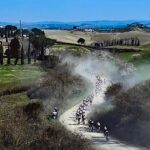
There are numerous events in Italy, with l’Eroica being the biggest and most famous. A bit apprehensive about the distance of that one instead Marina and friends rode the shorter La Polverosa. This means “The Dusty One.” They ride regularly and sport the classic blue jersey in homage to the Azzini-Freni Universal team of yore. There is a Freni Universal support van appearing at events and Giancarlo helps out.

Written by Federico and Sergio Meda, “Universal–The Champions’ Brake” was a commission of the Pietras. Freni Universal may live on now primarily as nostalgia but this is a charming and entertaining book.
The Pietra family is one of the sponsors of Giro d’Italia d’Epoca. This organization brings together non-competitive vintage cycling events across Italy (and now Brazil and San Marino too!). If this “community of slow, leisurely cyclists who meet at each stage like old friends and who meet new ones at each stage” appeals, you can find more information HERE.
“Universal–The Champions’ Brake” by Federico and Sergio Meda
English translation from the Italian by Andrea Bonfanti
176 pp., profusely illustrated, softbound
Corsa Classic, February 2026
ISBN 979-12-210-8475-7
Recommended price: 34 Euros
The book is available directly from the publisher HERE.
The post PEZ Bookshelf: Universal–The Champions’ Brake appeared first on PezCycling News.