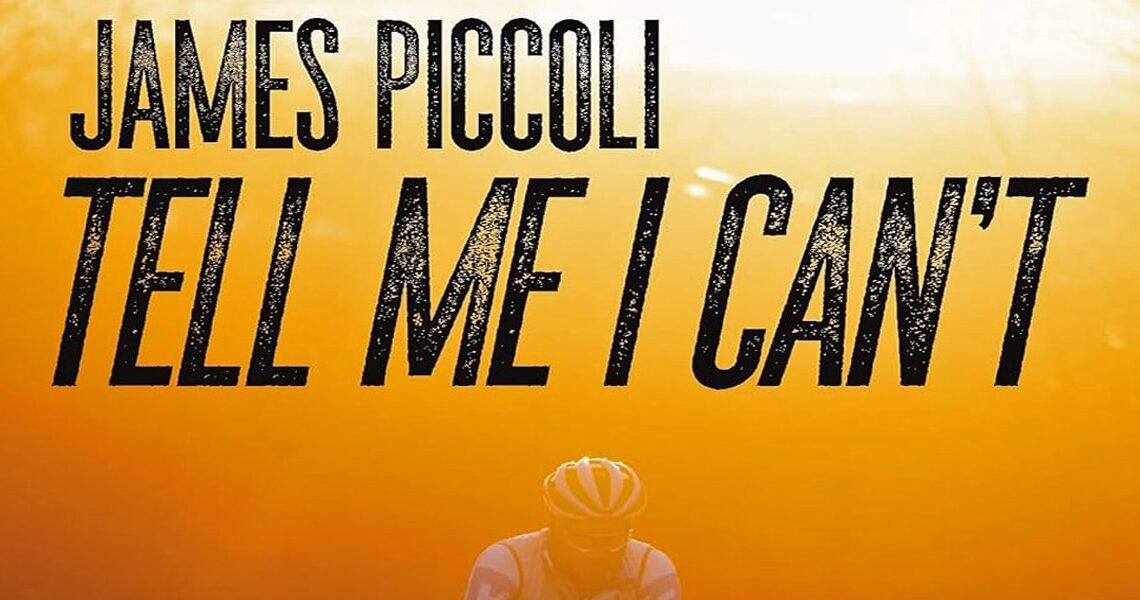

Last month we reviewed a book about Tadej Pogačar’s life and times HERE. That was the story of a youngster who came up through a racing support network in his home country before exploding onto the global cycling scene as a generational talent. Now in “Tell Me I Can’t” we have a book that tells a very different story. This is James Piccoli’s account of how he became a racer through sheer determination, making his way from the lowest level of professional teams to the UCI World Tour. Now retired, he can look back on a career that may have not been that of a generational talent but certainly a tribute to impressive doggedness.

The book opens with his decision, at age 20, to throw aside his uninspiring studies in mechanical engineering in his hometown of Montreal and become a pro cyclist. Although he had ridden a fair amount up to when he was 14 or so, this decision must have come as something as a shock to his comfortable family but one senses that if he was going to put in the serious effort they would be supportive. He had read the Malcolm Gladwell book about how it was necessary to put in 10,000 hours of practice to reach mastery in any given skill and so begins the story.
The outdoor training season in Montreal is very short so he takes advantage of his father’s connections to meet up for a DIY training camp with good club riders in Las Vegas. He so impresses someone there enough with his determination and potential talent that he receives an open invitation to stay and ride. He is grateful enough for the free accommodation to volunteer to do the cooking but otherwise seems to be pretty much on his own. No coach, no special training plans, no high-end equipment or testing but just a lot of time out on the roads in Nevada.
Winter over saw his return to Quebec and riding with amateur teams, trying to get noticed. He enters the Canada Games with his provincial team, hoping to attract the attention of Canada Cycling, the national development organization. He won a silver medal in the time trial and a bronze in the road race. His account of getting his first dope test is told with some humour as well as equal parts pride and humiliation. In spite of his good results, no call came from Canada Cycling. Instead he did get a message from an Italian Continental-level team about coming to race in Europe for a year.
Amor & Vita first began as an amateur club founded by a bike shop owner in Lucca, Tuscany in 1948. It turned professional in 1984 and after a meeting with the Pope in 1989 the team manager changed the name to “Amor & Vita,” or “Love & Life.” In its existence from 1989 until 2021 it was registered as a UCI license-holder in no less than eight different countries. There were some notable successes and more than a few doping incidents. Although not a rider for the team, Mario Cipollini was associated with it as he came from the same region in Italy.
James Piccoli’s time with Amor & Vita was a memorable introduction into the world of European pro racing. Promised a salary of 1,000 Euros for the year, he was housed in a dingy apartment with other racing wannabes and pretty quickly the gap between what one thinks of as a “professional” sports team and something at the Continental level was obvious. It makes for grimly entertaining reading. The first outing is with the great Cipollini himself, supplier to bikes to the team, and, well, the Lion King comes across exactly as one would expect.
The racing itself is an education but the penny-pinching of the team crosses over into low-level financial fraud. Told he will never be a pro cyclist (and short-changed by 800 Euros), Picolli returns to North America. In 2015 he joined another Continental team, H&R Block, registered in Canada, which appeared to have some ambitious plans. Needless to say, this outfit was even more half-assed than Amor & Vita and Piccoli eventually was without a contract.
Racing in North American event as a guest racer on short-handed teams he showed enough talent (and the ability to overcome an impressive amount of bad luck) to attract interest from yet another Continental team. This happens as he is back in Las Vegas and walking to buy ice cream, seriously considering giving up on racing. His cellphone rings and the Sports Director or Elevate/KHS Pro Cycling offers to bring him on as team leader. The ice cream is forgotten and a very different chapter in Piccoli’s racing life begins.
Until this point one feels that only his stubbornness has kept him going as most people would have given up. He has been marginalized when not ignored by Canadian cycling officialdom, dealt with teams that could only be considered professional in the most generous of views and which told him he would never be a pro cyclist, and earned almost no money. He was a good cyclist and even made his own custom carbon shoes but was going nowhere. But the three years with Elevate/KHS would change everything.
The management of the team carefully assessed talent and had a multi-year development plan. Strategy is actually discussed before a race and everyone had a specific job. Piccoli was brought in as the team GC leader and this was an adjustment too. It is clear from the book that he had the ability to read a race as well as to get the most out of his teammates. The chapter covering his 2019 season is riveting as it his last chance to gain the attention of cycling’s top level and makes a fitting ending to the book as he is on the verge of reaching the World Tour.
“Tell Me I Can’t” is a terrific story. There is no easy path for anyone wanting to become a professional cyclist and for a Canadian, with minimal support for a niche sport in unhelpful weather, it is even more so. James Piccoli’s tale shows what can be done by talented self-starters who do what they do for love. They will not be satisfied until they reach the limit but are adamant that it is up to only them to determine that limit.
“Tell Me I Can’t–Stories and Lessons from an Improbable Journey to the Top of Professional Sport” by James Piccoli
221 pages, softbound (also available in e-book form)
Stonehewer Books, Victoria, BC, 2026
ISBN 978-1-06-923624-1
Suggested price: US$17.95/C$23.95
Available from AMAZON.COM HERE.
The post Pez Bookshelf: Tell Me I Can’t appeared first on PezCycling News.