
Pro cycling never exists in a vacuum. The sport’s biggest stories—from Tadej Pogačar’s dominance at Strade Bianche to the rapid emergence of teenage talent like Paul Seixas—reflect deeper forces shaping the modern peloton. In this edition of AIRmail, The Outer Line looks beyond race results to examine the structural dynamics influencing the sport: the competitive balance among top teams, the growth—and challenges—of women’s professional cycling, evolving sponsorship models, and the geopolitical and economic factors that increasingly intersect with global sport. The result is a broader view of where pro cycling stands today—and where it may be headed next.
Analysis, Insight, and Reflections from The Outer Line.
# Catch up on pro cycling – and its context within the broader world of sports – with AIRmail … Analysis, Insight and Reflections from The Outer Line. You can subscribe to AIRmail here, and check out The Outer Line’s extensive library of articles on the governance and economics of cycling here. #
Key Takeaways:
● Is Pog’s Dominance Really Pog’s Fault?
● Seixas Again Demonstrates That He is For Real
● Advances in Women’s Sport, and Women’s Cycling …
● … But the Pipeline for Future WWT Talent is Concerning
● Impact of the Iran War on Sports
● Developments in Cycling Sponsorship

Tadej Pogačar won Strade Bianche for the fourth time in five years this past weekend, transforming the race into another signature long-range attack and solo ride into Siena. Trending criticism from some corners of cycling was that his dominance is starting to make the sport boring, but in our opinion, that says more about cycling’s expectations than about Pogačar’s dynamic racing style. In most other sports, the presence of a generational talent who repeatedly overwhelms opponents is celebrated as greatness, but cycling often treats this with disappointment because there is a tradition of fans and observers wanting to see champions suffer in victory and defeat. Rather, the uncomfortable reality is that Pogačar’s dominance reflects several of men’s pro cycling’s structural issues, such as the fact that his biggest rivals rarely meet him outside a handful of marquee races. Organizers also perpetually design courses that tend to favor his style of racing, so while Strade Bianche is one of the calendar’s most successful modern events, its course encourages long-range attacks. Perhaps in the future, organizers should structure tactically decisive obstacles nearer to the finale similarly to the Tour of Flanders and Milan-San Remo. If fans want more suspense, perhaps they should be criticizing other teams and race organizers, rather than Pogačar.

There are encouraging signs that the next generation is arriving even as Pogačar dominates. Behind the Slovenian, 19-year-old French prodigy Paul Seixas delivered the other great ride to single-handedly chase during the final hour and drag the gap back to a minute before dropping UAE’s Isaac del Toro on the brutal ramp into Siena. Seixas authored one the best performances from a teenager in the history of the sport despite falling short of Pogačar, bolstering hope that the sport’s rising youth movement may arrive sooner than expected. Seixas’s performances have not gone unnoticed by the leaders of the sport’s top teams, and it appears that there is already a race on to sign Seixas to his next contract when his neo-pro Decathlon CMA CGM agreement expires at the end of 2027.
Reportedly, Seixas has paused extension talks with his current team until after this year’s Tour de France, effectively opening the door for cycling’s richest organizations to begin preparing offers. Teams like UAE Team Emirates, Lidl-Trek, Red Bull–BORA-hansgrohe, and INEOS Grenadiers could all present enticing financial packages to lure Seixas away – though such a move would undoubtedly precipitate another round of hand-wringing over the big budget teams. Meanwhile, Seixas’ Decathlon team faces a structural disadvantage in that battle, since, as a French-registered team, it operates under payroll taxes that significantly increase the cost of paying elite riders. A team relocation across the border to Switzerland could reduce those costs and potentially fund a Seixas extension. And while it might seem like a drastic move for a long-running French team, there may not be another option to hold on to one of the country’s biggest homegrown stars.
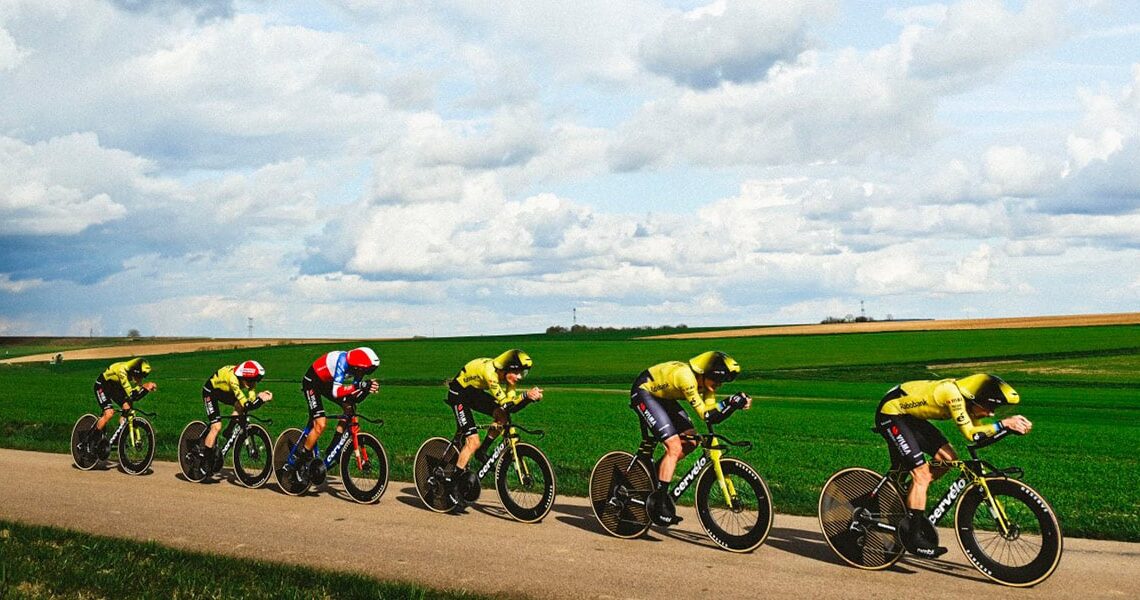
 Team Jumbo-Lease A Bike at Paris-Nice 2026 Stage 2
Aside from the Pogačar-Seixas contest, cycling’s generational pressure will also be on display this week at Paris–Nice, where Pogačar’s biggest Tour de France rival, Jonas Vingegaard, attempts to get his 2026 campaign back on track after a training crash and illness derailed his kickoff races. Vingegaard will face off in a high-stakes showdown against UAE’s Juan Ayuso. For the Danish rider, the race represents more than an early-season tune-up; it will practically require him to reassert himself as the sport’s primary challenger, since Pogačar just signaled that he is back and stronger than ever. Vingegaard also needs to send that message to the handful of younger contenders like Ayuso, who increasingly look ready to claim a spot in the top tier of GC contenders.

Fans who tuned in to watch the women’s Strade Bianche finale saw a thrilling and tightly contested finish with FDJ’s Elise Chabbey holding off Katarzyna Niewiadoma-Phinney of SRAM-Canyon. The nearly 500-meter long sprint was marked by tactical positioning, a leadout from Chabbey’s teammate Franziska Koch, and UAE’s Elisa Longo-Borghini and EF’s World Champion Magdeleine Vallieres pressuring Chabbey all the way through the final corners and finishing straight. The spectacle played out in a complete contrast to the men’s race. Unpredictable racing, innovative tactics, and the risks and rewards which play out in unconventional breakaways make women’s pro racing one of the most entertaining, if not undervalued, properties in pro sports today. Yet despite all the success and promise, there is a looming issue which the sport must overcome – and it is not dissimilar from core issues facing women socially and economically throughout the world.
The development pipeline in women’s cycling is under-capitalized, under-supported, and spread across too many priorities to remain stable in the near term. The talent which has risen to the top of the WWT represents the best in women’s road racing today, but the talent channel to replenish that peloton in the future is dangerously thin. In fact, it is estimated that the developing talent pool will not be able to support more than about six pro teams in the challenging WWT marketplace that is emerging. A similar impasse regarding calendar overload and player availability has hit women’s professional tennis, and the WTA’s new chairperson has called a competition council meeting – with player representation – to resolve the situation among tournament owners, broadcasters, and the athletes.
The UCI recently and formally sought stakeholder input on how to better manage and guide the sport – including the Women’s WorldTour – in the future. Thus, it seems critical that the Federation places a premium on direct athlete participation at the table during these discussions and focus on this future talent pipeline. The sport must build a separate development path for the WWT, one that decouples it from preconceived or legacy notions about how men’s racing has been run in the past. More to the point, investment priorities must change to refocus on programs which encourage children to ride and help more young women to pick up the sport competitively, building development channels up to a similar level as those in men’s cycling. It’s not just the current generation of champions aging out, but also the top support riders – and who will be ready to replace them over the coming several seasons?
In a similar vein, the WNBA may be closer to the first players strike in league history, according to several outlets. However, that outcome might not be unanimous among the players, with many voicing concerns in a players association meeting that if a new collective bargaining agreement isn’t signed by March 10, league activities would be severely impacted for the 2026 season. A counterproposal from the WNBPA to the league offered several concessions, and a marathon players’ meeting appears imminent. Debate among the players boils down to money: elite stars with seniority are not as immediately impacted by financial hardship as the talent sitting at a tier below the earning power of the league’s starters. In the WNBA, much like the WWT, talent alone doesn’t guarantee that an athlete isn’t living from hand to mouth even though they are competing on the sport’s biggest stage. Despite this perceived fracture in athlete solidarity, the fact that the players are acting in unison to align with common objectives indicates they are on track to achieve financial gains and competitive improvements in the next CBA. Cycling’s CPA and TCS athlete bodies should take notes as the WNBA’s pre-season drama nears conclusion.
The current elephant in the room in any conversation about global sports is the unstable geopolitics of the Middle East, with the likelihood of ongoing military action with Iran igniting a regional conflict every day that it continues. Many political analysts predict the situation will become a multi-year headache that will impact the globe in multiple ways, not just for the military toll, but also high oil prices that will contribute to economic stressors. Like many other conflicts in the Middle East, there is always the possibility for it to spill over into derivative terrorist attacks outside of the region. Pro cycling concluded its annual foray into the region a few weeks ago, but there are a host of other sports enterprises which have near-term events scheduled there – some of which are anchors in their respective calendars. For example, Formula 1 holds its Bahrain and Saudi Arabian races in April, and then returns for stops at Qatar and Abu Dhabi to close out its 26-race schedule later in the year; having to cancel or relocate those races will come at a very steep cost. Soccer leagues in the region have been suspended, and Iran’s participation in the World Cup is now in question. Meanwhile, controversy swirls around the country’s women’s soccer team which is stuck in Australia after the Women’s Asian Cup competition, and a debate is emerging over whether to offer all members of the team asylum there after five players defected last week.
 Team Ineos at Paris-Nice stage 2
There were a couple of major developments in terms of pro cycling team sponsorship issues over the last week. On the weekend, there were indications that Team Ineos secured a new title sponsorship with a yet-to-be-confirmed Danish IT company (Equinor or Netcompany, depending on the source), to the tune of €100 million over five years. It is expected that Ineos would remain as a secondary sponsor, and the Ineos boss Jim Ratcliffe would continue to own the team. Ineos has recently cut back its sponsorship dollars in other sports as well but still owns major stakes in the Mercedes Formula 1 team and the Manchester United football team. On the women’s side, Daniel Benson’s Cycling Substack reported that Red Bull is primed to make a major commitment to FDJ United-SUEZ team, which could provide the funding to tie Demi Vollering into a long-term contract and potentially bolster its talent development pipeline.
Cycling fans often despair about the doping attention which the sport inevitably seems to attract, although similar practices go on routinely, legally and generally unnoticed in other sports. However, this week, a story emerged from baseball which showed that even in these other major sports there comes a time when “enough is enough.” MLB announced that Braves’ designated hitter Jurickson Profar was suspended for 162 games after testing positive, for the second time, for exogenous testosterone. The suspension will cost him $15 million. In 2014, MLB increased the penalty for second-time PED offenders to a full season, and since that time, five other players have received a similar penalty. The sentence, however, still seems mild relative to what professional cyclists would pay under similar circumstances.
Written and Edited by Steve Maxwell / Joe Harris / Spencer Martin
THE OUTER LINE
www.theouterline.com
@theouterline
Visit our website for our latest articles and commentary. And check out our extensive Article Library for hundreds of in-depth articles about the economics, governance, structure and competition of pro cycling, organized by subject. (Advisory Group: Peter Abraham, Luke Beatty, Brian Cookson OBE, Nicola Cranmer, Prof. Roger Pielke, Jr., Dr. Bill Apollo and Prof. Daam Van Reeth.)
The post Outer Line AIRmail: Pogačar’s Dominance, Seixas Rising, and the Future of Women’s Cycling appeared first on PezCycling News.