
Pro cycling’s Opening Weekend didn’t just deliver cobbles, crosswinds, and familiar winners — it exposed the shifting power dynamics of the 2026 season. As Mathieu van der Poel asserted dominance at Omloop Het Nieuwsblad and new stars like Matthew Brennan and Paul Seixas signaled a generational turnover, the sport found itself navigating deeper currents beyond the finish line. From a forthcoming Netflix documentary on Moriah Wilson, to a cycling-linked name emerging in the Epstein Files, to renewed but thinly sourced doping speculation and a Supreme Court-triggered tariff battle involving Trek Bicycle Corporation and Specialized Bicycle Components, the sport’s competitive narrative is increasingly intertwined with cultural, legal, and economic forces. The 2026 season may be decided on the road — but its storylines are unfolding everywhere else as well.
Analysis, Insight, and Reflections from The Outer Line.
# Catch up on pro cycling – and its context within the broader world of sports – with AIRmail … Analysis, Insight and Reflections from The Outer Line. You can subscribe to AIRmail here, and check out The Outer Line’s extensive library of articles on the governance and economics of cycling here. #
Key Takeaways:
● Racing’s Opening Weekend: Old Stars and New Stars
● Mo Wilson Film Planned
● A Cycling Name Emerges From the Epstein Files
● Unfounded Suggestions of New Doping Scandals
● New Sports Stadiums
● Bike Companies Sue Feds to Recover Tariff Payments

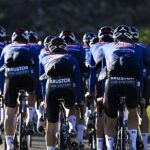
Pro cycling’s unofficial “opening weekend” didn’t just mark the return of cobbles and crosswinds; it reinforced the contours of cycling’s current hierarchy. At Saturday’s Omloop Nieuwsblad, Mathieu van der Poel turned a near-crash on the Molenberg into a runaway solo victory over Red Bull-Bora-Hansgrohe’s Tim van Dijke and UAE’s Florian Vermeersch. The more interesting subplot wasn’t that Van der Poel won, it was that Van Dijke and Vermeersch collaborated with him in the front group, knowing they would likely be dropped later. Racing for second and third ahead of likely crash chaos is perhaps the only logical play in today’s era – where the surest way to beat a generational rider is to hope they have a mechanical.

This win might have signaled the beginning of another paint-by-numbers Van der Poel spring, but Visma-Lease a Bike showed signs of resurgence twenty-four hours later at Kuurne-Brussel-Kuurne, even as questions swirl about the Dutch team’s financial future. After being present in seemingly every move throughout the tough race, the team perfectly delivered 20-year-old sprinting sensation Matthew Brennan to the line for his first Classics win. It felt like a return to the “total cycling” blueprint that defined their 2022–2024 run: pressure everywhere, options everywhere, commitment only at the decisive moment. With the weekend seeing a key support cog in Tadej Pogačar’s spring plans, Tim Wellens, go down with a broken collarbone, along with Decathlon and Red Bull-Bora flashing impressive team strength, we could be heading into the Classics season with deeper competition than we’ve seen in recent years.

Meanwhile, out of the limelight in southern France at the Faun-Ardèche Classic, nineteen-year-old Paul Seixas quietly signaled that, along with Brennan and Isaac del Toro, the established stars may have a tough time holding onto their empires in 2026. Seixas transitioned from prospect to the real deal when he rode away from a stacked field with over 40 kilometers to go, casually dropping defending Paris-Nice champion Matteo Jorgenson and climbing the 20-minute Saint-Romain-de-Lerps at a reported ~7.2 W/kg and and riding to a nearly two-minute solo win. The numbers were eye-popping; his composure was even more so. In a sport currently defined by a small clique at the top, Seixas’ rapid trajectory threatens to break up the establishment, perhaps even as soon as this year’s Tour de France.

Moriah Wilson, the acclaimed young gravel cyclist who was tragically murdered in Austin, Texas in 2022, will be the subject of a new documentary. It was announced this week that Netflix will release a film about the cyclist’s life and murder, to be entitled The Truth and Tragedy of Moriah Wilson. The film is being directed by experienced documentarian Marina Zenovich, an Emmy-winning director who has also made films about Lance Armstrong, Robin Williams and Roman Polanski, among others. The film will premiere at the SXSW Festival in Austin this month and on the global streaming platform later this year. “Mo” Wilson’s story was also recounted in a long New Yorker magazine article in 2022 which drew sharply mixed reviews.
The names of several major sports investors have surfaced in the Epstein Files over the month or so since the first three million pages were made public. However, the vast majority of names logged in the various transcripts, emails, and ledger entries amounts to a mundane directory of billionaires, over-capitalized individuals, and institutions who invested in the disgraced pedophile’s various financial vehicles. It is likely that this rogue’s gallery will continue to grow as the next few million pages are released, but notably, at least one name related to pro cycling has now surfaced.

Thom Weisel, one of the former backers of Tailwind Sports which managed the USPS cycling team sponsorship through its glory days, has three entries (EFTA01460974, EFTA01419169, and EFTA01419592) in Data Set 10 of the public files. These relate to Annual Client Update real estate financial ledger notes kept by Epstein’s staff, which contain account numbers (now redacted), their financial health, personal and family details, and future outlook in the portfolio. (The entries are from 2015 – well after Epstein’s 2008 sex crimes plea deal in Florida.) Along with information about Weisel’s financial state ($10,875,395 invested) and risks, his financial integrity is flagged by a note: “8-12-13: There is negative media surrounding Lance Armstrong and Thomas Weisel’s sponsorship company, Trail Wind (sic). Investigation is ongoing with the civil suit.” Weisel founded Montgomery Securities – a financial institution that fueled many Silicon Valley successes and which sponsored two professional cycling teams prior to USPS. Weisel is a longstanding board member of USA Cycling and the U.S. Ski and Snowboard Team.
Discussions around doping in pro cycling always seem to be in a perpetual state of “smoke” but typically without much real fire. Unfortunately, cycling may always be associated with cheating and doping in the broader public, but factually the sport has done more than almost any other in terms of cleaning up its act over the last 25 years – since its darkest hours. Those efforts following WADA’s founding – including the independent CADF testing agency, the Athlete Biological Passport program, the UCI’s pivotal Cycling Independent Reform Commission of 2015 – have been well-documented in the media over the past decade or more. However, that doesn’t seem to stop a broad spectrum of rabid fans – and occasionally more knowledgeable cycling journalists – from regularly engaging in an endless and often tiresome debate about competitive performances and the prevalence of doping in the sport today. In one of the latest and more high-profile reiterations of that trend, an article last week in the New York Times Athletic provocatively suggests that infractions are taking place today in broad daylight, and that new doping scandals are coming – but offers virtually no substantive evidence to back up those assertions.
Given cycling’s history, any hint or allegation of doping is always sure to attract ample clicks from viewers. According to the Times’ piece, “sources close to the UCI” apparently think that we need a new doping scandal – “that a prominent figure being sanctioned for doping would be a healthy development, proof that the anti-doping program is functioning.” The article also suggests that “transparency and openness have given way to secrecy” in terms of doping issues. And even after quoting various officials and stating that “most riders, managers, staff, agents and political figures in the sport” believe that “there’s no reason to fret over the credibility” of the sport, the article nevertheless concludes that “distrust within the sport has reached levels not seen for a while.” Drumming up claims of doping in pro cycling is always sure to generate clicks (150 comments at last count) but without any kind of solid evidence, this kind of article serves no real purpose, and unfortunately only prolongs and reinforces the negative side of the sport’s history.
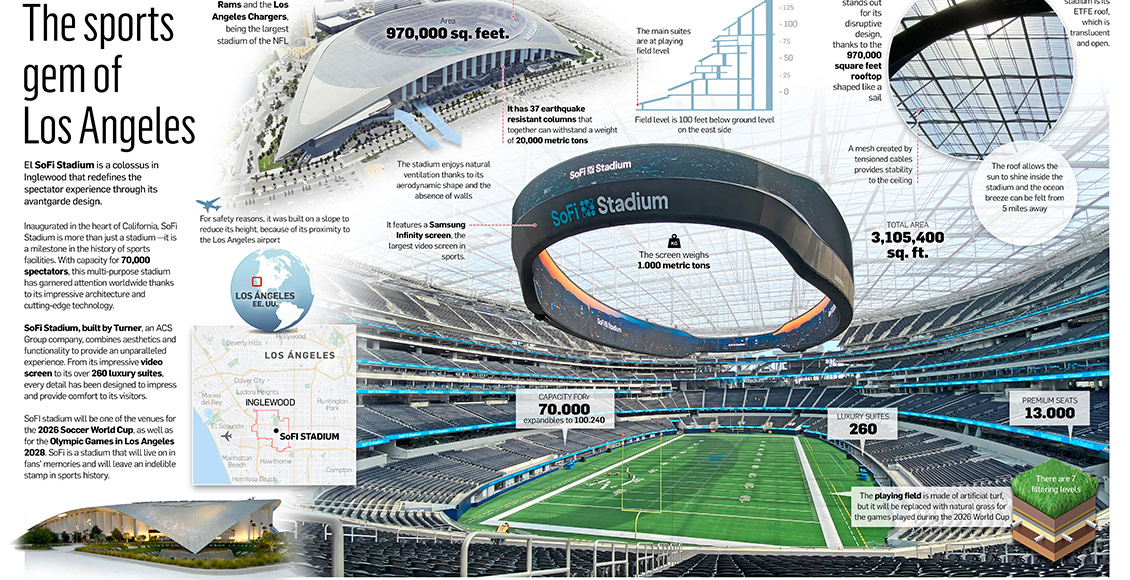
One of the oft-recurring stories in sports media revolves around new stadiums – new homes for teams, often in new geographic areas to meet perceived fan demand, complete with a variety of new amenities or as part of larger entertainment complex investments, or even as part of an effort to woo teams away from a prior market, and so on. In a recent article, the venerable New Yorker magazine asks if “the race to create ever more lavish spectator offerings in America’s largest entertainment venues is changing the fan experience?” Ever since the Houston Astrodome opened in the mid 1960s, America has seen a race to imagine, design and build bigger and better, often indoor stadiums, in which to watch sports as well as a wide range of other entertainments.

Using Los Angeles’ multi-billion dollar SoFi stadium development as an example, author John Seabrook discussed the way in which stadiums have come to represent and dominate their cities; “they often require years of regulatory permitting before ground is broken. Local and state governments are much less inclined to finance these projects than they used to be, in part because they’re too expensive and in part because economic studies consistently show that owners, not taxpayers, derive most of the financial benefits.” In this light, the expenses, permits, and human efforts to promote and deliver world class road racing seems a comparative bargain despite the rising costs in recent years – a virtual and open arena showcasing not just a single sporting complex, but an entire city and surrounding region while creating commerce opportunities in the midst of exciting and competitive action. Cycling might benefit from the fundraising, financing, and organization lessons from successful stadium projects to create sustainable races in high value locations in the future.
After the Supreme Court ruled last week that President Trump’s tariff actions were not constitutional, several bike manufacturing companies announced that they would sue the Federal government to recover the tariff amounts that they were forced to pay under the International Emergency Economic Powers Act, which the administration utilized to justify the earlier tariffs. According to Bicycle Retailer, the parties involved include Trek, Specialized and Shimano, as well as a host of other smaller bicycle companies, apparel and equipment manufacturers and outdoor retailers. Most of the legal cases are essentially identical, and they ask the court “to enjoin the government from collecting more of the tariffs and to refund tariffs paid with interest and other costs, including legal fees.”
Written and Edited by Steve Maxwell / Joe Harris / Spencer Martin
The post Opening Weekend Shake-Up, Doping Rumors & Tariff Lawsuits: Cycling’s Turbulent Start to 2026 appeared first on PezCycling News.