
The Birth of Cycling’s Premier Event
The 1927 Championship featured only professional men at the start. Nine countries sent riders to compete in Germany. The 188-kilometer course tested climbing and sprinting skills. Alfredo Binda finished ahead of Costante Girardengo for Italy’s first rainbow jersey.
The UCI wanted a true test of national cycling strength. Team tactics played a crucial role from the first edition. Countries selected their best riders regardless of trade teams. This format created unique racing dynamics compared to regular season.
Entertainment Beyond the Race
Championship followers often seek other forms of competitive entertainment. Online gaming sites attract people who appreciate strategy and calculated risks. These sites let new users test their offerings before committing money. Trial periods help people decide if they want to continue.
Budget-conscious users appreciate promotional offers that reduce entry barriers. Casino sites compete by providing bonus codes to attract new members. Users testing casino games can claim $50 free chip no deposit bonus promotions that give bonus credits for slots, blackjack, roulette, and other table games. These free chips require wagering between 30x-60x the bonus amount before withdrawal. Players explore different game types and strategies during the bonus period.
Understanding game mechanics through free play builds confidence for real betting. Strategic thinking applies whether racing bikes or playing table games. Both activities reward patience, timing, and smart decision-making. This connection explains why cycling fans often appreciate gaming sites too.
Binda’s Three-Peat Dominance
Alfredo Binda won three consecutive titles from 1927-1932. He took gold in 1927, 1930, and 1932 championships. The Italian cycling federation paid him not to race in 1929. They wanted other riders to have winning chances too.
Binda’s tactical intelligence set him apart from rivals. He read races better than anyone in that era. His sprint could beat pure speed specialists. Climbing ability let him survive mountain courses others couldn’t.
Coppi vs Bartali Rivalry
Fausto Coppi and Gino Bartali divided Italy in the 1940s-50s. Coppi won the world title in 1953 at age 34. Bartali claimed his championship in 1946 after the War ended. Their rivalry defined post-war Italian cycling.
Political tensions made their battles more than sport. Coppi represented progressive northern Italy in many eyes. Bartali stood for traditional Catholic southern values. Race results carried weight beyond just cycling outcomes.
The 1948 Giro d’Italia saw their most famous battle. Coppi attacked on the Cuneo-Pinerolo stage in rain. Bartali couldn’t match Coppi’s pace that day. This moment shifted Italian cycling power for years ahead.
Merckx’s Triple Crown Year
Eddy Merckx won the Worlds, Giro, and Tour in 1974. He attacked solo 70 kilometers from finish in Montreal. Nobody could follow the Belgian’s brutal acceleration uphill. Merckx finished 58 seconds ahead of Raymond Poulidor.
The 262-kilometer course featured Mount Royal circuit repeated 19 times. Each lap included steep climbs testing rider strength. Merckx dominated despite being marked by every team. His power exceeded all competition that day.
This win completed Merckx’s second triple crown season. He had done this before in 1972. No rider has matched this double triple crown since. The 1974 performance stands as pure dominance peak.
Hinault’s Home Victory
Bernard Hinault won the 1980 championship in Sallanches, France. The course featured 22 laps of a brutal Alpine circuit. Temperatures dropped below freezing during the race. Many riders quit due to cold and difficulty.
Hinault attacked with 20 kilometers still remaining. He rode alone through freezing rain. French fans lined the route despite terrible weather. Hinault won by almost 2 minutes over Giuseppe Saronni.
This victory proved Hinault’s status in French cycling. Mental toughness matched his physical gifts. The rainbow jersey gave him confidence for years ahead. Hinault went on to win five Tour de France titles.
Key Championship Innovations
The championship evolved through several important changes:
- 1927: First men’s professional race held in Germany
- 1958: Women’s championship added in Reims, France
- 1994: Time trial world championship started
- 1996: U23 men’s category introduced for development
- 2012: Team time trial added to program
- 2019: UCI introduced equality in prize money
LeMond’s Comeback Win
Greg LeMond won 1989 worlds just months after a near-fatal shooting. Doctors said he might never race bikes again. LeMond proved them wrong at the Chambéry circuit. He out-sprinted three riders after 258 kilometers.
The American had 30 shotgun pellets still in his body. Recovery took two years of painful work. This championship showed his return to top form. That year he won the Tour de France by 8 seconds.
LeMond’s victory inspired countless comeback stories after. His mental strength matched his physical recovery. The rainbow jersey proved all his rehab efforts worthwhile. He showed that determination beats terrible odds sometimes.
Cipollini’s Lone Rainbow
Mario Cipollini won only major title in 2002. The sprint specialist got his perfect course finally. The Zolder circuit in Belgium favored pure speed over everything. Cipollini beat Erik Zabel in the final sprint.
The Italian had been close many times before 2002. Bad luck and wrong courses prevented earlier victories. Zolder’s flat profile suited his characteristics perfectly. Team Italy controlled the race for their sprint ace.
This win meant more to Cipollini than many expected. He called it a career highlight despite 189 pro wins. The rainbow jersey holds special meaning for all riders. Cipollini proved he could win beyond just the regular season.
Sagan’s Hat Trick
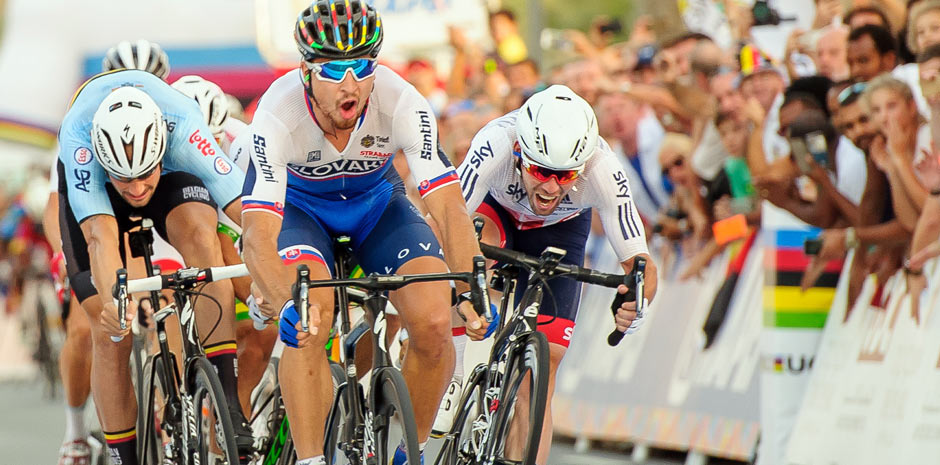
Peter Sagan won three straight titles 2015-2017. He matched Binda’s record from the 1930s era. The Slovak’s bike handling skills proved crucial over and over. Sagan won through positioning rather than pure power.
Richmond 2015 saw Sagan attack the final corner perfectly. Doha 2016 victory came from a sprint in desert heat. Bergen 2017 required climbing and tactical patience. Three different courses all suited Sagan’s adaptable style.
His success came from reading races better than others. Sagan always positioned himself perfectly in the final kilometers. The rainbow stripes gave him commercial value too. He became cycling’s most marketable rider during this period.
Modern Era Tactical Evolution
Today’s championships feature data-driven race strategies. Teams use power meters and radio communication now. Coaches track riders through GPS in real-time. This technology changed tactical decision making totally.
The 2023 Glasgow championships showed a modern approach clearly. Teams shared data about wind direction and speeds. Positioning mattered more than ever in final laps. Mathieu van der Poel won through perfect late positioning.
Aerodynamics matter more than pure strength sometimes now. Equipment advances give measurable advantages in sprints. Riders optimize everything from helmets to sock height. Marginal gains philosophy dominates the modern cycling approach.
Conclusion
The World Championship Road Race created legends across almost 100 years. The rainbow jersey remains cycling’s most prestigious prize. From Binda to Sagan, champions defined their eras total. Future riders will add new chapters to this rich history.
The post Iconic Moments of the World Championship Road Race appeared first on PezCycling News.