
Product reviews can often trend towards the mundane. Reviewers like to keep things coldly analytical and “scientific.” We weigh everything, wax poetic over torque values, grams and aero-profiles as we push the “tech is king” mantra on most products crossing our path.
This isn’t that. Ok, well it is some of that, but the first thought I had upon opening the box from Gulo Composites and pulling out their gravel all-purpose GGA 38 wheels was a sense of nostalgia for my Mavic G.E.L. 280’s circa 1987. The Mavic’s were my first custom wheels, built around the iconic American Classic hubs with 28 spokes front and rear, and rolling on Vittoria Corsa CX tubulars, they were true Race Wheels back when “train heavy, race light” was the order of the day.

Amazingly (or not) I wasn’t very easy on parts back then and might have ignored the “race only” mantra a time or ten. As a newbie racer thrashing all around town on rims that weighed just over half a pound each, you can guess how long they lasted. Happily, my skills and wheel tech have improved a bit over those 40 years, which brings us to Gulo Composites and their GGA 38’s
Gulo is a small company based in Brevard, North Carolina that is working to be one of those legendary micro-brands that shakes up the industry. Think of the original SRAM, home of the GripShift bar end twisters that took Bob Mionske to a 4th place finish at the ’88 Olympics in Seoul, long before a swath of strategic acquisitions helped catapult it to the forefront of the industry.

Or consider Time and their ATAC pedals from the early 90’s, a true revolution in performance, and still the standard raced around the World. Zipp was another small brand that brought massive innovation to market with their dimpled rim surfaces (becoming one of those strategic acquisitions by SRAM along the way).
Perhaps Specialized Bicycles, an equipment importer for half a decade before their first branded product, the Specialized Touring Tire, gave them perch and paved the way to the iconic “Stump Jumper”, which launched them into the cycling stratosphere, said it best: “Innovate or Die!” Gulo may not have that mantra on a masthead, but they certainly embrace the ideal, so let’s give ‘em a look.
The Company – What the Gulo?
Gulo Composites is an independent off-shoot of KEIR Manufacturing, a 43 year old leader in technical ceramic and composite manufacturing for a wide variety of industries and applications; they make items as diverse as ceramic nozzles for sandblasting, composite bows for archery, and “hot zone” components for high temperature furnaces, to name just a few. Given that composites and carbon are a specialty, it’s a logical step that they would delve into a niche market like wheel manufacturing.

Gulo started in 2017 with a composite spoke that was designed “to bring new strength, smoothness, and precision to bike wheels.” The company name actually derives from the scientific name for the Wolverine genome Gulo gulo – relentless, resilient and agile. Brand manager Chad Davis leads a small crew of cycling lifers who truly embrace the sport and want to make meaningful contributions that are true “game changers.”
The 411 
GGA-38 / WTB Radler 44mm
Out of the box Gulo’s GGA 38’s, a hookless gravel focused wheelset (more on that later) tip the scales at 612g up front, and 733g at the rear for a total system weight of 1345g without tires, cassette or rotor, a mere 18g or 0.7 ounces (1.3%) off the claimed 1323g weight from the website.

These rims alone weigh 390g/ea unbuilt and feature 24 “G-spoke” carbon spokes built up 2-cross on both front and rear and laced to Gulo’s ETI system hubs with a variety of available cassette compatibility options. Internal width is 25mm, with a 32mm external width, both ideal for today’s wider tire standards. The wheels came with tubeless valves and rim tape pre-installed and were ready to go in just a few minutes. Simply mount, add sealant, pump them up and spin on the rotors, 140mm front and rear in my case. Another surprise came in the box as Gulo supplied a 3oz ounce bottle of sealant, enough for several rounds of tire changes (what luck!).

Spoke Innovation

Something in the Spokes
Let’s take a closer look the “G-spokes”. Gulo claims a spoke weight of 3.7g each, including titanium ferrules and internal nipples. Several replacement spokes were included making it easy to address the claim that the spokes weigh “half of an aluminum spoke”. I threw one on the scale and even with the big titanium end pieces the spokes tipped the scale at a mere 4g each, on point considering my scale didn’t have values after the decimal below 10g.

The 4g spoke weight represents a laudable 39-53% improvement on a “typical” 6.5-8.5g steel spoke like the Sapim CX-Sprint used in Zipp 303’s or 30-36% compared to the 5.7 – 6.3g listed weight the classic DT Swiss Competition double butted spoke. On a “typical” 24 spoke wheel that equates to a savings of between 60g and 108g depending on specifics of the build. Impressive, but Chad also alluded to a “new” spoke and hub combination they hope to debut soon that takes another gram off the spoke weight, dropping to a claimed 2.7g each. If the final version meets that ambitious goal it will equate to a savings of between 144g to 278g against the competitors noted above, a full 1/3 to half a pound lighter on the bike.

While weight is always a factor, Gulo would probably give the greater emphasis to the technology and innovation of the spokes themselves. Chad noted that, while proprietary, the essence of the manufacturing process is what makes the spokes “fundamentally different from every other spoke on the market” and Gulo is “the only brand using a braided fiber architecture rather than a purely unidirectional layup.”
According to Chad, this “solves two major limitations to other carbon spokes: poor impact resistance and a harsh ride feel.” He noted that UD spokes are very stiff, but also quite brittle, transmitting vibration directly into the wheel and impacting overall ride quality. The G-Spoke, on the other hand has an additional reinforcement material giving the spoke a greater impact strength than a steel spoke.
This combination makes the spokes not entirely composite, but allows the braid angles to be fine-tuned to deliver the intended ride, a roughly 8% reduction in vibration, while maintaining significantly more lateral stiffness out of corners and accelerating. Add a 20% higher tensile strength than steel and you get a more robust wheel that needs less maintenance and holds tension and trueness longer.
Heady stuff, for as Chad put it “What excites us most is that we’re bringing real innovation to a part of the bike that hasn’t fundamentally changed in over a century. Steel spokes were invented in the late 1800s, and the technology has barely evolved since.”
The Ride
The CGA-38’s use a hookless design for tire retention. I hadn’t ridden hookless on a road set up, and admit a bit of trepidation at the thought, but fortunately there are people who look at these things with a trained eye and deep commitment to safety who have.
But First, Let’s Talk About Tire Pressure
The main consequence on the road is a much tighter tolerance for maintaining the right tire pressures. Most manufacturers use a maximum pressure limit of around 72psi or 5 Bar, as established by both the European Tyre and Rim Technical Organization (ETRTO) and the ISO, the International Organization for Standardization, but as with most things it’s the details that matter.
The ISO has a standard “blow off” test protocol that runs tires up to 110% of their specified maximum, in the ETRO/ISO World of 72psi maximum that leaves a fairly paltry amount of wiggle room, all of 7lbs, especially when factors like friction and ambient temperature changes during a ride can account for a significant percentage of that range. Then consider that pumps are typically off by some percentage as well, further impacting the safety zone.
The “solution”? Wider tires run at much lower pressures. That’s why hookless has been used successfully for Mountain and Gravel applications where bigger tires need less pressure to reach their performance maximum. The same holds true on the road more and more these days as we are riding wider tires there too. Although the embrace of hookless on road is still a work in progress the technology keeps improving on both tires and rims that may make hookless as ubiquitous as clipless pedals. With that out of the way, let’s ride…
Now We Ride
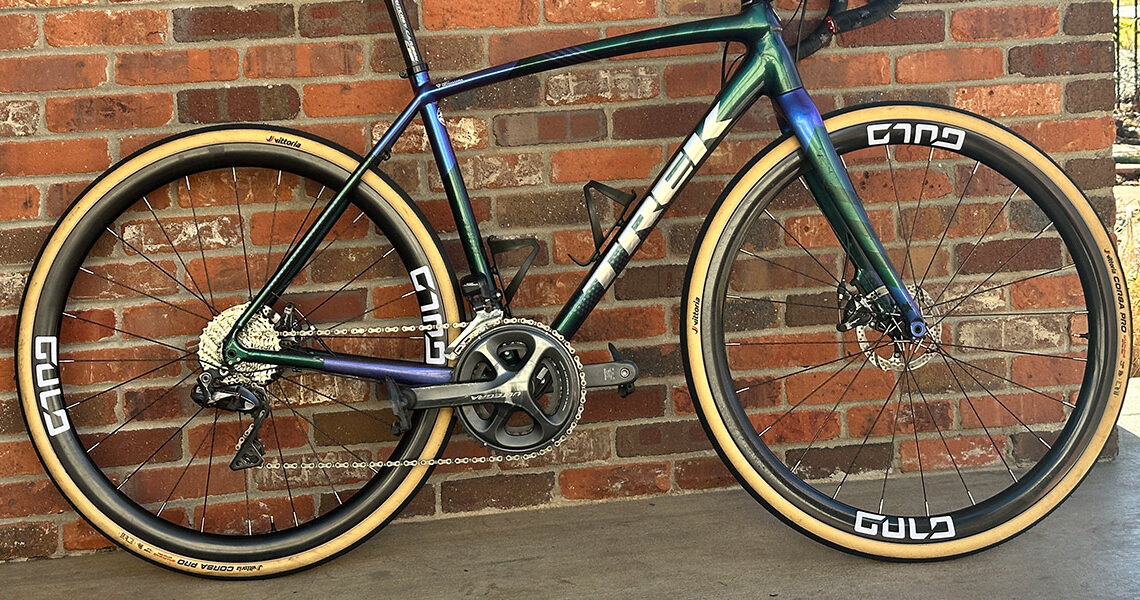
I rode the GGA-38’s with two different bikes and 3 different sets of tires over multiple rides, curious to note the differences. I started with a set of 44mm WTB Raddlers on a Trek Crockett that covers everything from road to ‘cross and gravel, a truly versatile bike. When mounted the 44’s measured a bit narrow, 40mm at ~40psi. The first ride was set-up for Gravel Nationals in Minnesota.
The course was a combination of road, gravel and a bit of single track – a nice variety of conditions to put the Gulo’s through their paces. The first challenge I encountered was the Crockett tire clearance. When climbing the narrower chain-stays and a little bit of wheel flex had the tires rubbing the front derailleur just enough to annoy and impact efficiency on pitches above about 4%. On the positive side the tires worked great across all surfaces otherwise, so I decided to test them on a Specialized Crux, which has a claimed max tire width at the chain stay of 47mm.
True to form the WTB’s ran well on the Crux offering good clearance and allowed the wheels to shine. Gulo claims an 8% reduction in vibration from the carbon spokes. While quantifying this on a ride is mostly perception, I can say that the overall impression was that the wheels DO dampen the impact of rougher terrain. The dampening was even more noticeable on some of the washboards inherent to gravel riding.
Singletrack with it’s many undulations offers yet another affirmation of the benefits of combining the bigger tire volume, lower pressure, and the braided carbon spokes into a seamless ride. The wheels had no lag on turn initiation, snapping over on lean ins and quick to change deflection on small course corrections.
I mixed it up by swapping to a set of Vittoria Corsa Pro 32mm road tires for some riding. The 32’s seated up easily and immediately felt buttery smooth rolling out of the house. I set my pressure at about 55psi and was off excited to see how they ate up tarmac. 320 TPI (threads per inch) tires on a nice set of rims at lower pressures still feels like the lap of luxury every time.
The GGA-38’s felt effortless to turn and snappy on those little accelerations like jumping to make the light and trail braking into a corner to late apex into one of those gorgeous arcs that should come with an accompanying cameraman to record the moment. They never put a foot wrong, even under hard braking and aggressive line changes just to see if I could throw them off.
I didn’t launch any full gas sprints, or drop an PR efforts downhill, more out of fitness than fear, but did drop and hop a few curbs, up and down, along the way. I also rode across a variety of pavement from freshly laid perfection to some of the “roads” around Tucson, Arizona more akin to hardscrabble hiking than actual roads. Admittedly the tires played a role. The Vittorias offer a very nice ride, and are pretty durable if you treat them with kindness. I continued to ride them on the road just because they are so smooth, fast, and fun to ride. That said, as the only tire of the road portion, I don’t think I’d go below a 32mm tire and keep a watchful eye on my gauges.
Last up the Maxxis Ravager, also in 40mm, but measuring 32mm on the calipers. Similarly easy to install, the Maxxis, like the WTB’s, measured surprisingly narrow when mounted. Despite measuring cyclocross legal on the wheels, the Maxxis cornered well, the side knobs not prone to sliding out even when braking or turning on loose surfaces, though I didn’t push the lean angle too much. The lighter file-tread pattern wasn’t noticeably different than the others on gravel, but the 120 TPI thread count did offer a more compliant ride than the 60 TPI Maxxis’.
In reality, I actually preferred the firmer Maxxis sidewall for rougher conditions as it was a little more confidence inspiring regarding sidewall roll and connection. I’d be curious to try a more aggressive overall knob profile on more technical terrain as well, to see if the wheel flex is more noticeable, perhaps something like either a slick-rock trail with sharper edged, or a more rock strewn trail offering bigger hits to push the rims farther
Overall Impression
It is great to see companies innovating despite the proliferation of in-house big equipment specs on bikes. Product managers and buyers often get much better pricing by combining items from a manufacturer, so to get the chance to ride a novel approach to wheel craft was a great opportunity. Gulo has combined their innovative braid-based carbon composite spokes with a well thought out and tightly built hub and rim mix that tips the scales at under 1400g and is useable for gravel and road set-ups, the later requiring a bit more diligence in care and maintenance of the tighter pressure constraints. I didn’t have any flats or problems with the tires, so I can’t speak to ease of repair (yay), though I’d think the usual benefits and hassles of tubeless would be present.
The GGA 38’s occupy a real World friendly US$1,995 price per pair, well inside similar offerings of other, bigger manufacturers.
In addition to the Gravel 38’s Gulo has a new Ultra-Wide Aero wheel for gravel that is 44mm wide with a 30mm internal rim width to maximize tire volume. The Ultra-Wide’s are a hybrid hooked construction costing $2,195 and weighing 1395g. At the other end of the spectrum the GGA-SL Superlights strip another 100g of the total system weigh of the 38’s, tipping in at 1225g, thanks in part to a 23mm rim profile vs 38mm’s on the slightly heavier wheel.
On the road and mountain bike Gulo has similarly opted for 3 different wheel options. Mountain bike includes “Trail” and “XC” versions and they also make a 1680g “Enduro” wheelset for the big hit crowd. Enduro’s are also 40mm external and 32mm internal rim widths with a 24mm rim depth. Asymetric spoke offset is standard on all MTB wheels.
Road options include “super light”, “aero” and “all-around” versions ranging from 1281g to 1368g, each offering traditional “hooked” clincher style compatibility if you’ve yet to adopt 30mm+ tires. All 9 wheelsets sit in the aforementioned sweet spot of $1,995 – $2,195 making them a great option for a durable, good looking and more pliant ride or race on two wheels. I have to say I came away impressed with the ride quality brought by the innovation and am curious to see where they tread next.
• See more in at the Gulo Composites website
The post GULO COMPOSITES GGA-38 WHEELSET Review appeared first on PezCycling News.