
Here at Gear Break, longer days are suddenly upon us in the Northern Hemisphere–and they’re getting longer. As our Southern Hemisphere friends slide into winter, we–in the North–are marching steadily toward spring now. Before we get started, it’s Friday the 13th…

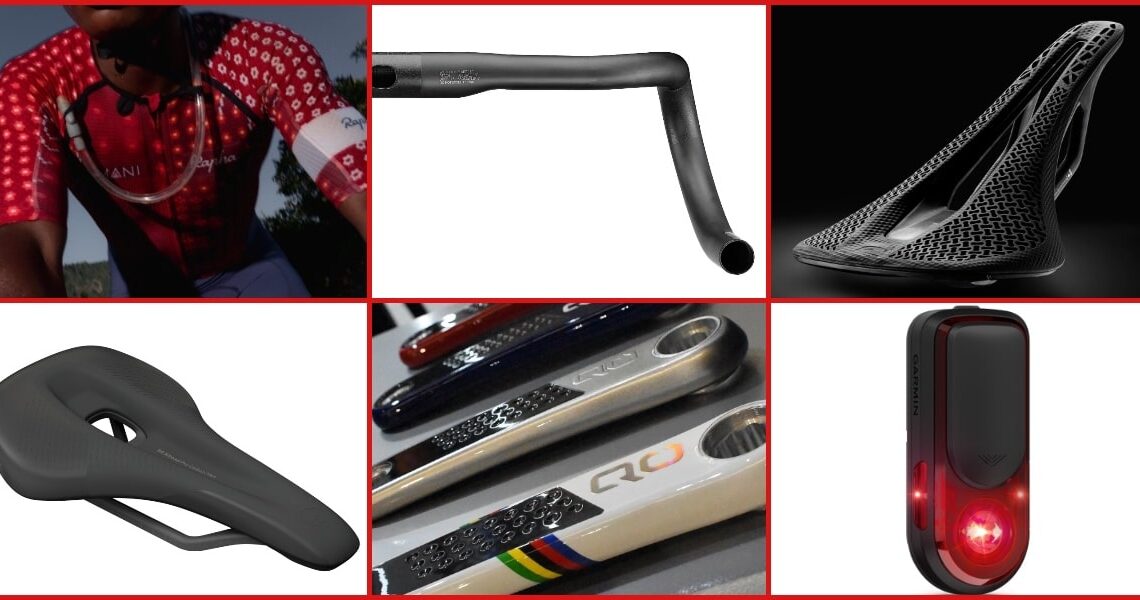
In anticipation of the coming riding season, and for Andy in particular the coming gravel, we’ve got some great pieces of kit for you this week. While not intentionally gravel road focused, there’s plenty here this week for all road and gravel riders: a 3D printed saddle from CADEX and a “allroad” focused carbon saddle from Ergon, the new GARMIN RearVue 820 radar/taillight, new QO cranksets with some cool features for the rougher stuff, new Team AMANI kit from Rapha, and lastly the CADEX GX handlebar for allroad and gravel hijinx.
CADEX Amp 3D Saddle—$450.00
Performance Amplified

Per CADEX:
The Amp 3D saddle combines cutting-edge 3D-printed G3D gyroid infill with an ultralight carbon base for unmatched comfort, efficiency, and performance. Its precision-tuned structure optimizes pressure distribution, minimizes weight, and absorbs road vibrations for a smoother ride. Designed for maximum power transfer and durability, the Amp 3D delivers the perfect balance of support and speed.
- Exclusive Gyroid Structure: High-resilience EPU 3D-printed padding integrates a cutting-edge gyroid design, delivering superior pressure distribution, enhanced support, and maximum comfort at minimal weight.
- Precision-Tuned G3D Padding: 3D-printed gyroid infill padding allows precise variation in density across the center of the saddle, optimizing support and comfort in key pressure zones while keeping weight to a minimum.
- Optimized Performance Shaping: A crowned profile that quickly drops away at the wings increases pedaling space, improving fit options and reducing clearance issues.
- Smooth-Edge, Truncated Nose: Minimizes inner thigh interference for unrestricted pedaling motion.
- Advanced Forged Composite Technology Base: A low-seated, SMC carbon base eliminates flex, enhances support, and maximizes pedaling efficiency.
- Integrated Rail Design: Relieves pressure points while improving compliance for a smoother ride.
- Ergonomic Center Cut-Out: Reduces pressure on soft tissue areas for long-lasting comfort.

CADEX specs 145 grams for weight
Amp 3D key specs
Chuck sez: PEZ readers may remember my review of the CADEX Amp saddle. As the name implies, the Amp 3D saddle is the same saddle but with 3D printed padding instead of traditional foam padding. Going 3D comes at a price. The Amp 3D costs $100 more than the “regular” Amp saddle.
Design-wise, the Amp 3D is the same as the regular Amp saddle:
- It’s a short-nose saddle (245 mm — the UCI limit is 240 mm)
- Curved shape
- An ample center cutout to help reduce pressure on the important bits
- It only comes in one width: 145 mm

The carbon fiber base and rails are also the same as the regular Amp saddle. They are made via Advanced Forged Composite Technology. Most carbon fiber composites are made with continuous layers that are “laid up.” Forged composite is composed of small pieces of carbon fiber that are pressed into shape as the resin cures. This process allows for a wider range of shapes (such as thickness transitions and compound curvature) to be formed with precision relative to traditional carbon fiber.
One thing to know is that forged carbon fiber isn’t as strong as woven or unidirectional (UD) carbon fiber (the latter being the strongest). That doesn’t mean the forged composite rails on the CADEX Amp are weak — just not as strong as woven or UD. If that creates some concern, CADEX has what it calls a Composite Confidence support plan (in addition to CADEX’s warranty and service policies):
We’re so confident in CADEX’s composite technology, if any composite component is structurally damaged while you’re riding in the first two years after you bought it, we’ll repair it or replace it free of charge.
Just keep in mind that “it only covers damage done while riding, so don’t go driving into your garage with your bike on top of your car. That’s on you.”

Curved saddle profile
Is it for you?
Is the Amp 3D saddle for you? That’s a question I can’t answer definitively because saddle choice is very personal. What’s comfortable for one person can be a total PITA (quite literally) for another. So YMMV and your decision will be based on a variety of factors, including:
- Your anatomy (particularly sit bone width)
- Your flexibility
- Your position on your bike
- Your riding style

Ample cutout for undercarriage comfort is really a channel that runs the full length of the saddle
What I can say is that I’m a fan of short-nose saddles like the Amp 3D that offer these potential benefits:
- They allow you to lean forward more and get lower into the aero position more comfortably by reducing pressure on soft tissue
- The nose of the saddle is usually wider than traditional saddles, providing more of a platform for sitting when the rider wants to ride “on the rivet”
- Short-nose saddle design is supposed to encourage riding in a more fixed position, offering better stability and better weight distribution, because you’re not moving around as much
- A short-nose saddle provides increased clearance for the quads and hamstrings because there’s less saddle to get in the way

100 percent black carbon fiber goodness
And my butt is a fan of the curved design (both front-to-back and side-to-side) of the Amp 3D saddle. Curiously, because my back is still pretty flexible for my advanced years (I can touch my toes, which is part of my regular stretching routine), most manufacturers would recommend a flat saddle shape for me. But I’ve test ridden flat saddles and they’re completely uncomfortable for me. One of the reasons why it’s so important to test ride saddles and not necessarily go entirely by a manufacturer’s recommendation.

The ride experience
Given that I found the regular Amp saddle a comfortable ride, I had no reason to believe I wouldn’t have the same experience with Amp 3D saddle. But I put the Amp 3D saddle to a slightly different test. Instead of riding it on one of my road bikes (either my Colnago V3 or LOOK 795 Blade), I put it on my KICKR BIKE PRO. In many ways, I think doing so is actually a more “rigorous” test because riding on Zwift or ROUVY is largely a seated affair. You’re pretty much firmly planted and “fixed” on the saddle for the duration. And there isn’t any natural bike movement, which can be a comfort factor. So any uncomfortableness is going to make itself more apparent (and sooner). I’m happy to report that the Amp 3D saddle has been comfortable for me on 2+ hour indoor training rides.
I also experienced #marginalgains comfort from the Amp 3D’s 145 mm width. Like the Amp saddle, the back end of the Amp 3D saddle is more T-shaped than Y-shaped. It’s probably not as noticeable riding IRL, but sitting up to take a swig out of my water bottle or towel off sweat on indoor rides I could feel and appreciated the extra real estate to park my butt.

The bottom line
But I’m sure the question PEZ readers have is whether the $100 premium to go 3D is worth it? What the 3D printed padding provides is the ability to more precisely dial in the firmness/density of the padding in different parts of the saddle to better distribute/relieve pressure. I have no way to objectively test/measure, but just using my thumbs for tactile feedback:
- The back third or so of the saddle was more on the “soft” side
- The middle third or so felt the firmest
- And the nose felt softest (the printing pattern is also more “open”)

Whether this means that the Amp 3D saddle will be more comfortable than the regular Amp saddle (or any other traditional padded saddle), I can’t say definitively because it’s subjective and specific to each rider. But my (indoor) riding impressions:
- I felt like I was more sitting “on top” of the Amp 3D saddle rather than “in” it (my experience with other 3D printed saddles is similar).
- Also similar to other 3D printed saddles I’ve ridden, the “padding” feels firmer that the foam padding of traditional saddles.
- As a result, I also felt like I was more “in contact” with the saddle. I could definitely feel the saddle under me, but no pressure points (if you’ve ever sat on the wooden beads seat covers that a lot of taxi users — and that I have on my computer chair, that’s a good analogue).
- It’s worth noting that the 3D printed material can be a little “grippy,” which helps keep you positioned on the saddle. Although not quite as smooth as a traditional saddle cover, I could still move around on the saddle easily enough.
Finally, there’s this: IMHO the 3D printing just looks cool.
Garmin RearVue 820—$299.99
The OG has a successor

Garmin has officially announced the latest evolution in its safety ecosystem: the Varia RearVue 820. Serving as the successor to the long-standing industry benchmark, the Varia RTL515, this new radar tail light brings a host of modern hardware updates and advanced detection capabilities designed to provide cyclists with a clearer picture of the road behind them.
We’ve got the key details and specs for you today, but stay tuned. We have a test unit on hand, and we will have a full review up soon.
Advanced Vehicle Tracking and Threat Detection
The headline feature of the Varia RearVue 820 is its Advanced Vehicle Tracking. While previous models focused on the closing speed and distance of approaching traffic, the RearVue 820 utilizes more precise radar technology to categorize vehicles by size—identifying them as small, medium, or large (such as a motorcycle, car, or semi-truck).
The device also introduces side-to-side movement tracking. This allows the radar to detect if a vehicle is changing lanes or making a “hook” maneuver, providing a categorized threat level on compatible Edge cycling computers or the Varia smartphone app. Additionally, a new same-speed tracking feature ensures that vehicles following at the cyclist’s pace remain visible on the display rather than “dropping off” the radar.
Brighter and integrated brake light

Visibility sees a significant boost with a 100-lumen day flash, making the unit visible from up to 2 km (1.2 miles) away. For the first time in this specific form factor, Garmin has integrated a flashing brake light pattern. The device detects when a rider is slowing down or stopping and automatically changes the light’s rhythm to alert motorists.
Connectivity and hardware have also been modernized. The RearVue 820 finally moves to a USB-C charging port and includes a redesigned seatpost mount that offers a more secure fit for various road and gravel frame geometries.
Comparison: Varia RearVue 820 vs. Varia RTL515
The Varia RearVue 820 offers significant leaps in battery life and detection range over the RTL515. These advacnes apply no matter how you use the radar/light.
The greater battery life of the RearVue 820 comes at the cost of about 20g heavier weight than the RTL515. For 20g, the battery life is significantly longer, which in turn means less charge cycles and a longer service life for the battery. The larger battery–along with USB-C to comply with EU regulations–is now replaceable, at cost.
We have not tested the detection ranges yet, but the consensus thus far is that the detection range exceeds Garmin’s stated spec and every other available radar unit currently in the market. We are excited to test this and get you a real world assessment. One key feature that distinguishes the RearVue 820 from the RTL 515 is the ability to distinguish the size of the closing target (passenger car, moto, semi truck/lorry) and it’s location in the road. This promises to be a big technological leap forward for situational awareness and safety. We are excited to get this onto our seat post and test it out. Some of these advanced features, however, are only available on Garmin’s own Edge x40/x50 head units.

| Feature | Varia RTL515 RTL515 | Varia RearVue 820 |
| Radar Detection Range | Up to 140 meters | Up to 190 yards (175m) |
| Radar Field of View | 0 Degrees | 60 Degrees |
| Max Brightness (Day Flash) | 65 Lumens | 100 Lumens |
| Brake Light Feature | No | Yes |
| Vehicle Size Classification | No | Yes |
| Battery (Day Flash) | Up to 16 Hours | Up to 24 Hours |
| Battery (Radar Only) | N/A | Up to 30 Hours |
| Charging Port | Micro-USB | USB-C |
| Weight | 71.0 g | 90.0 g |
The Bottom Line
The Varia RearVue 820 is available now from Garmin, and other retailers, worldwide. It is offered in a StVZo compliant version, just like its predecessor. It carries a suggested retail price of $299.99 | 299,99€ |£259.99. Stay tuned, Garmin has furnished Pez a test unit, and as teased above, we will be back soon with a detailed writeup of our on-road test.
QO Cranks
A new mould is forged

If the names Pablo Carrasco and Ignacio Estellés sound familiar, they should. As the visionary engineers who founded Rotor in 1996, they spent decades redefining drivetrain efficiency with oval rings and CNC-machined masterpieces. Now, they are back with a new venture: QO.
Launching with a “blank slate” approach, QO is stepping away from Rotor’s signature aluminum machining to embrace high-end carbon fiber construction. Their debut lineup includes three discipline-specific cranksets—Race, Grava, and Rocks—designed to offer a premium blend of stiffness, aerodynamics, and impact resistance. QO are also teasing a Race SL (super light!) version for later this year.
The QO Lineup: Road, Gravel, and MTB
All QO cranks utilize Mitsubishi Pyrofil carbon fiber and feature a modular design. They are built around a 28.99mm spindle (DUB compatible) and use a 45-tooth DIN spline direct-mount interface (the same standard found on Rotor cranks), making them highly adaptable across various frames and drivetrains. By moving to a ground-up carbon design, Carrasco and Estellés have delivered a system that manages to be both lighter and more “intelligent” than its predecessors. By using specific layups and designs optimized for each discipline, QO cranks claim to dampen fatigue-inducing vibrations while being optimized for peak power transfer in each given discipline.
QO RACE (Road)

Designed for the tarmac, the Race model features “Aero Dimples”—a surface texture reminiscent of a golf ball intended to reduce drag.
- Construction: High-modulus carbon with aerodynamic shaping.
- Weight: 372g (arms + spindle); approx. 624g (complete with 50/34T rings).
- Arm Lengths: 160, 165, 170, 172.5, 175mm.
- Compatibility: 1x or 2x (110×4 BCD spider). Optimized for Shimano 12-speed and SRAM AXS.
- MSRP: Starting at ~€750 / $749 (complete).
QO GRAVA (Gravel)

The Grava blends the aero efficiency of the road line with “KevTex” reinforcement—Kevlar shields at the crank ends to protect against the inevitable rock strikes of off-road riding.
- Construction: Carbon fiber with Kevlar-reinforced tips.
- Weight: 478g (complete with 170mm arms and 40T ring).
- Arm Lengths: 165, 170, 172.5mm.
- Compatibility: 1x direct-mount; compatible with Shimano 12-speed and SRAM 12/13-speed chains.
- MSRP: Starting at ~€700 / $679 (complete).
QO ROCKS (MTB)

Built for the rigors of trail and XC, the Rocks model prioritizes impact durability. It features the same KevTex shielding as the Grava but adds “MaxStrength Slots” to tune compliance for better vibration damping on rough terrain.
- Construction: Reinforced carbon with holographic protective accents.
- Weight: 444g (complete with 170mm arms and 34T ring).
- Arm Lengths: 165, 170, 175mm.
- Compatibility: 1x direct-mount (55mm chainline). Supports Shimano and SRAM 12-speed.
- MSRP: Starting at ~€650 / $619 (complete).
The Bottom Line
QO isn’t just another carbon component brand; it is a calculated evolution from the minds that mastered aluminum machining at Rotor. With a modular spindle architecture and specialized tech like the KevTex armor, QO provides a high-performance, “fit-and-forget” solution for riders looking to shed grams without sacrificing real-world durability or performance.
| Feature | QO RACE (Road) | QO GRAVA (Gravel) | QO ROCKS (MTB) |
| Material | Mitsubishi Pyrofil Carbon | Pyrofil Carbon + KevTex | Pyrofil Carbon + KevTex |
| Unique Tech | Aero Dimples | Aero Dimples + Kevlar Tips | MaxStrength Slots + Kevlar |
| System Weight* | 624g (50/34T) | 478g (40T) | 444g (34T) |
| Arm Lengths | 160, 165, 170, 172.5, 175mm | 165, 170, 172.5mm | 165, 170, 175mm |
| Spindle / BB | 28.99mm (DUB Compatible) | 28.99mm (DUB Compatible) | 28.99mm (DUB Compatible) |
| Compatibility | Shimano/SRAM 12s (1x or 2x) | Shimano/SRAM 12 & 13s (1x) | Shimano/SRAM 12s (1x) |
| MSRP (Approx.) | €749 / $749 | €699 / $679 | €649 / $619 |
For all details and direct purchasing, head over to qobike.com.
Rapha AMANI Collection
The spirit of East Africa

East Africa is a heartland of record-breaking runners responsible for incredible feats of human endurance but the region’s potential for cycling is largely untapped. That’s where AMANI comes in. Based for much of the year in Iten’s “Home of Champions”, AMANI riders train in Kenya’s Great Rift Valley at 2,400m above sea level.
Founded in 2020, AMANI addresses the structural inequalities that have long kept African cyclists out of the top tiers of global competition. From limited access to international races and lack of high-performance infrastructure, to barriers in visa, travel, and sponsorship systems, the obstacles have been many – but not insurmountable.
Inspired to achieve new heights

The program has enjoyed off-road success in Africa and beyond. Now, AMANI’s freshly-minted UCI Women’s Continental team aims to replicate that on the road. Their stated aim is to reach the Tour de France Femmes avec Zwift by 2028.
Inspired by multi-hued fabrics that reflect centuries of craftsmanship, Rapha’s 2026 collection for Team AMANI brings the heritage of East African printing and materials to proven aerodynamic apparel. From the Kanga of Kenya to the Congolese Kuba, in East Africa, cloth is culture. Patterns and materials are passed through generations.

Across the Rapha + Team AMANI capsule you’ll find recurring motifs representing sunshine, peace, and energy. The flower Adey Abeba, an emblem of Ethiopian new year (Enkutatash) is used in repeating patterns across garments. A visual hook with a deeped history. Look closely and you may even find an intentional irregularity or two, in homage to the authentic humanity of hand-woven textiles. The sharp tones of the collection are achieved by taking natural dyes as a base and adapting them into a contemporary palette.
What Team AMANI are saying
Lorot Lawrence sez: “The mix of green, blue and red reminds me of textiles used in Uganda, pulling tradition into our team design. The flowers are very recognisable to all of East Africa. I’m excited to wear them all year.”

Eyerusalem Haftu Reda sez: “The yellow flowers on the shoulder represent our New Year as part of the Ge’ez calendar in Ethiopia.”
Xaverine Nirere, standout talent, sez: “There are many inspirations from all the riders’ countries on this kit; it is special to have the Imigongo pattern from Rwanda represented.”
Design and development
The goal of the collection was to deepen the regional connection through visual design. Photographer Finley Newmark worked with local stylist Kennedy Mirema on the campaign. They looked to the foundational materials of East Africa, specifically Sisal, which remains a staple across Uganda, Rwanda and Ethiopia for the crafting of traditional attire. Its presence in the story as a flower-spared headpiece serves as a tribute to the craftsmanship and textures that define the region.
The Cowrie shell carries an ancient association with prestige and power, having served as a sacred currency across the continent for centuries. Inspiration for the flower crowns came from the Surma people of Ethiopia, who wear flowers and natural elements as headpieces to show pride, beauty and identity.

Availability
The new AMANI team kit will available to Rapha Cycling Club members from February 19, and general public from February 20. At press time, Rapha have not stated pricing or which pieces will be made available in the new prints. From the press kit, it appears that the kit will include at least the Pro Team Bib Shorts III, Pro Team Aero Jersey, and an aero-optimized race suit. Head over to Rapha.cc for full details, including pricing next week.
Ergon SR Allroad Pro Carbon—$219.95
“The Wildcard”
Ergon is doubling down on its commitment to the gravel and all-road scene by supporting its neighboring German brand, Canyon, and the newly launched Canyon × DT Swiss All-Terrain Racing team, affectionately known as “The Wildcards.” This discipline-blurring squad is built to tackle everything from the UCI Gravel World Series to ultra-endurance epics like the Tour Divide. To handle the relentless vibration of multi-day grinds and technical tracks, the team will be equipped with Ergon’s flagship SR Allroad Pro saddles and BT handlebar tapes.

The Saddle
The SR Allroad Pro Carbon has bene in the market for several years now, but the choice to use this saddle by the team is a clear statement to its excellence. Designed specifically for the modern rider who doesn’t stop when the pavement ends, it strikes a precise balance between a firm, sporty road feel and the necessary damping for “allroads” and gravel chatter.
- Carbon Everything: Features a carbon composite shell and 7×9 oval carbon rails to keep the weight down to a minimalist 175g–195g (depending on size).
- OrthoCell® Pads: Unlike traditional gel, these high-performance inlays are lighter and more durable, providing better pressure distribution and a faster rebound to follow pelvic movements.
- Anti-Friction Side Flanks: A subtle but critical detail that reduces inner-thigh friction during high-cadence pedaling.
Gender-Specific Ergonomics
Ergon remains a leader in anatomical research, offering the SR Allroad in distinct Men’s and Women’s models.
- Men’s Model: Features a deep, rearward-tapered relief channel to protect the sensitive perineal area.

- Women’s Model: Designed with a wider, more forward-placed relief opening to accommodate the specific anatomy and pelvic tilt of female riders, preventing numbness and pressure peaks.

- Two Sizes: Both versions come in S/M (9–12 cm sit bone width) and M/L (12–16 cm sit bone width) to ensure a tailored fit.
Availability and Pricing
The gender specific saddles are both priced at $219.95. As of press time, both saddles in all sizes are available from Ergon.
CADEX GX Handlebar—$450.00
The Ultralight Gravel Command Center
We don’t often double up equipment from the same brand in a single Gear Break, but here we are. CADEX has been carving out a reputation for high-performance carbon components that don’t just shave grams, but actually rethink how a bike should feel. And we couldn’t ignore the CADEX GX Handlebar any longer. It is their definitive answer for gravel riders looking to balance racing efficiency with the rugged demands of unpaved terrain.

This week we are giving you a preview, because like the Garmin unit above, Andy has one that was just mounted to his gravel bike, and with the melting snow in Michigan, it is about to see some action. We are going to give you the technical info today, and come back for a full review in a few weeks.
Key Features & Design
- One-Piece Construction: Utilizing Precision Carbon Fiber Layup, the GX is a one-piece composite bar that eliminates the flex points found in traditional bonded bars.
- D-shaped bar tops feature a subtle, flattened oval shape. This isn’t just for aerodynamics; it’s designed to provide “tuned” compliance, absorbing high-frequency vibrations before they reach your wrists.
- Integrated Versatility: It is fully Di2 compatible, featuring internal routing ports that keep your cockpit clean and snag-free—a must for those running handlebar bags.
Geometry & Dimensions

The GX isn’t just a flared road bar. CADEX mapped its dimensions specifically for technical stability. Yes, it can be used on tarmac, but it shines when the roads turn rough and maybe even a bit after they end.
| Feature | Specification | Impact on Ride |
| Flare | 16° | Increases leverage and stability when descending in the drops. |
| Outsweep | 5° | Provides a more natural wrist angle for long-distance comfort. |
| Backsweep | 5° | Shortens the reach slightly, keeping the rider more upright on the tops. |
| Drop/Reach | 115mm / 70mm | Compact dimensions for quick transitions between hand positions. |

Availability and Pricing
The bar can be sourced directly from CADEX, or select retailers. As noted above, it retails for an MSRP of $450. CADEX offers the bars in 400, 420, 440, and 460mm widths as measured at the hoods, center-to-center.
Note: If you have other experiences with gear or something to add, drop us a line. We don’t claim to know everything (we just imply it at times). Give us a pat on the back if you like the reviews or slap Andy in the head if you feel the need!
PezCycling News and the author ask that you contact the manufacturers before using any products you see here. Only the manufacturer can provide accurate and complete information on proper/safe use, handling, maintenance, and or installation of products as well as any conditional information or product limitations.
The post Gear Break: Longer Days — CADEX AMP 3D Saddle, Garmin RearVue 820, QO Cranks, Rapha Amani Collection, Ergon SR Allroad Pro Carbon, CADEX GX Handlebar appeared first on PezCycling News.