
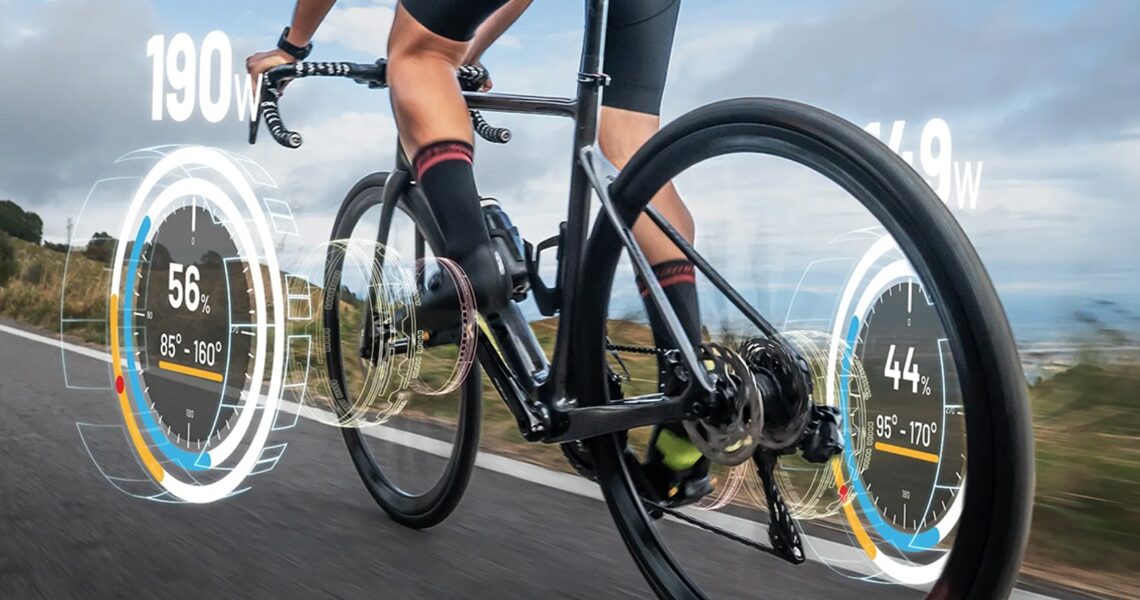

Power meters have transformed modern cycling, but not all power data is created equal. From crank-based systems like the long-established SRM to pedal-based options such as the Favero Assioma Duo, today’s riders have more choices than ever for measuring watts on the road and trail. While placement on the bike affects convenience and bike-to-bike transfer, what truly matters is accuracy, reproducibility, and sensitivity—because unreliable data can undermine training decisions and long-term performance tracking. A new 2026 study published in the International Journal of Sports Physiology & Performance takes a close look at how the Favero Assioma Duo stacks up against the longtime gold standard SRM crank system, offering timely insight into what cyclists should really be evaluating when choosing—and trusting—a power meter.
 Early SRM prototype powermeter – c. 1986
Power meters have become ubiquitous for professional, elite, and even many recreational on- and off-road cyclists. You can place power meters on many places on a bike: cranks, hubs, bottom bracket, and pedals. While each location has their advantages and limitations in terms of proximity to your actual cleats and switchability between bikes, the priority should be on their accuracy, reproducibility, and sensitivity. How does the Favero Assioma Duo pedal-based power meters compare to the long-time standard of the SRM crank-based power meter?

Roughly 35 years ago, the first SRM power meters ushered in a new era of data availability and analysis. Besides their use in real world riding, can you imagine a world now without smart trainers and virtual cycling?
Power meters are indeed great but, as with any measurement tool, it is important to understand how good that tool is. As the age-old adage goes: “garbage in, garbage out.” I’d rather have no power data for my training than have a power meter whose data I can’t trust.
Key Measurement Parameters
A few key definitions are required to differentiate concepts you should consider with power meters or any measurement tool. Let’s take as an example a good old bathroom scale:
Accuracy or Validity: Is it actually measuring reality? If you actually weigh 75.0 kg, is the scale telling you 75.0 kg?
Reproducibility or Precision: Will it give you the same measure every time, regardless of whether it’s accurate or not? Maybe your scale doesn’t tell your accurate weight of 75.0 kg, but each and every time you step on it tells you 76.0 kg.
While it’d be nice to have a scale that’s both accurate and precise, if I had to choose one I’d rather have a scale that is precise rather than absolutely accurate. That’s because I’m most interested in tracking my own changes over time.
Another relevant criteria is sensitivity. How much resolution does the scale have? Can it detect changes only of 0.5 kg? 0.1 kg? 0.05 kg?

Bouzigues et al. 2026
In the February issue of International Journal of Sports Physiology & Performance (I just took over as the Editor-in-Chief), a French group compared the Favero Assioma Duo pedal-based power meter to the SRM crank-based power meter (Bouzigues et al. 2026). How did they do this?
- 11 recreational to competitive athletes (9 men, 2 women) from a variety of individual and team sports. I would assess them as more recreational than high-level athletes, with 4.9±4.1h of aerobic training a week.
- The figure shows the test protocol, consisting of a series of different submaximal through to high-intensity 1 min efforts, both seated and standing. This was followed by a power profile maximal efforts from 5 seconds through to 20 minutes.
- All testing was done on a B’Twin Triban road bike on a Tacx Flow Multiplayer T1901 rear-wheel mounted trainer. Tyre pressure was kept constant.
- An SRM (Gen 8) power meter was used, with 8 strain gauges, 200 Hz sampling rate, and 1 Hz recording rate. Both the SRM and FA were calibrated according to manufacturer’s recommendations. The FA pedals used firmware 4.25.
- The FA pedals were recorded with a Garmin Edge Explore computer, while the SRM transmitted to a Garmin Fenix 3 watch with the same technology.

How did the SRM and FA Compare?
Accuracy. For both power and cadence, the FA consistently read slightly higher than the SRM. Across all conditions (sitting, standing, workloads), the increase was about +1.63W. The bias was higher at higher power outputs, and also when standing compared to sitting. Keep in mind that the pedal is the first point of contact with the rider, with the cranks being slightly further downstream, so a higher bias for the FA can be expected.
Cadence was systematically higher with the FA, but we’re talking 0.3 rpm so not really significant in real life.
The correlation between power values for the FA and SRM was very strong overall, so the two power meters tracked very consistently overall despite the slightly higher values for FA.

Reproducibility. The purpose of the multiple tests at the same wattage was to test reproducibility. For the FA, across all tests, the mean power was 201.46±15.9 W. Divide the values and you get a Coefficient of Variation of 7.89%. This level of reproducibility may be acceptable depending on your use, but it may limit the FA’s use for precise longitudinal tracking.
Think of it this way. You do an all out effort and your value is 200 W. You train and 3 months later repeat the effort and it’s now 210 W. Since the difference is within the range of variability, did you actually improve your fitness or is it just measurement noise? Arguably, you’d need to hit an improved test score of 220 W to be quite certain it’s actual fitness gains and not measurement error.
This goes back to what I wrote in the Introduction. Most power meters (and smart trainers) claim ±1% or ±2% accuracy. I’d much rather they tell me their reproducibility or precision.
Sensitivity. The sensitivity of the FA was high, with the data suggesting that it can discern changes as low as 3 W.
Summary
Overall, this study highlights the Favero Assioma Duo, but it raises bigger questions about power meters (and smart trainers) in general that we should all keep in mind when using them and analysing the data.
First and foremost, zero and/or calibrate your power meter every chance you can. “Zeroing” your power meter before every ride according to manufacturer guideline is a start (resetting your bathroom scale to zero before you step on it), but this is different from actual calibration (actually testing the power meter against set and known loads). In some cases like SRM, this requires sending it to them every so often for a full calibration. Many other power meters there’s simply no way for you to calibrate them.
Understand the difference between accuracy and reproducibility. Know that manufacturers only tell you the former, but arguably the latter is much more important to know.
We haven’t even touched upon the issue of whether different units of the same power meter are equally accurate/reproducible. From what I can discern, this study used a single pair of FA pedals. Would the results differ with another set of FA pedals?
The big takeaways: 1) take care and service your power meter. 2) understand the strengths and limits of your power meter data.
Ride fast and far, and have fun!

References
Bouzigues T, Salas J, Candau R, Brioche T (2026) Accuracy, Reproducibility, and Sensitivity of the Favero Assioma Duo Pedal Power Meter Comparing to the SRM Gold Standard. International Journal of Sports Physiology and Performance 21:192–201. https://doi.org/10.1123/ijspp.2025-0323
The post Favero Assioma Duo Power Meter Pedals – Accuracy, Reproducibility, & Sensitivity? appeared first on PezCycling News.