
The Tour Down Under may be the first WorldTour race on the calendar, but its implications now extend well beyond Australia, offering an early snapshot of competitive imbalance, climate risk, and the growing influence of superteams. At the same time, developments across the wider sports ecosystem — from Davos-led economic forecasts and shifting media models to political identity, salary caps, and digital misinformation — are reshaping how sport is played, funded, and consumed. This week’s roundup looks at how those threads converge, and what cycling can learn from the broader sporting world as it navigates an increasingly complex and globalized future.
Analysis, Insight, and Reflections from The Outer Line.
# Catch up on pro cycling – and its context within the broader world of sports – with AIRmail … Analysis, Insight and Reflections from The Outer Line. You can subscribe to AIRmail here, and check out The Outer Line’s extensive library of articles on the governance and economics of cycling here. #
Key Takeaways:
● First Race of the Year – TDU – Sets the Tone
● Davos Group Weighs In On Global Sport
● Cyclocross Season is Evolving
● The Political Leanings of Pro Athletes
● NCAA Sports Spending – Lessons for Cycling?
● Digital Misinformation in Sports

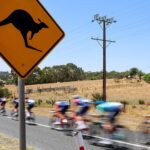
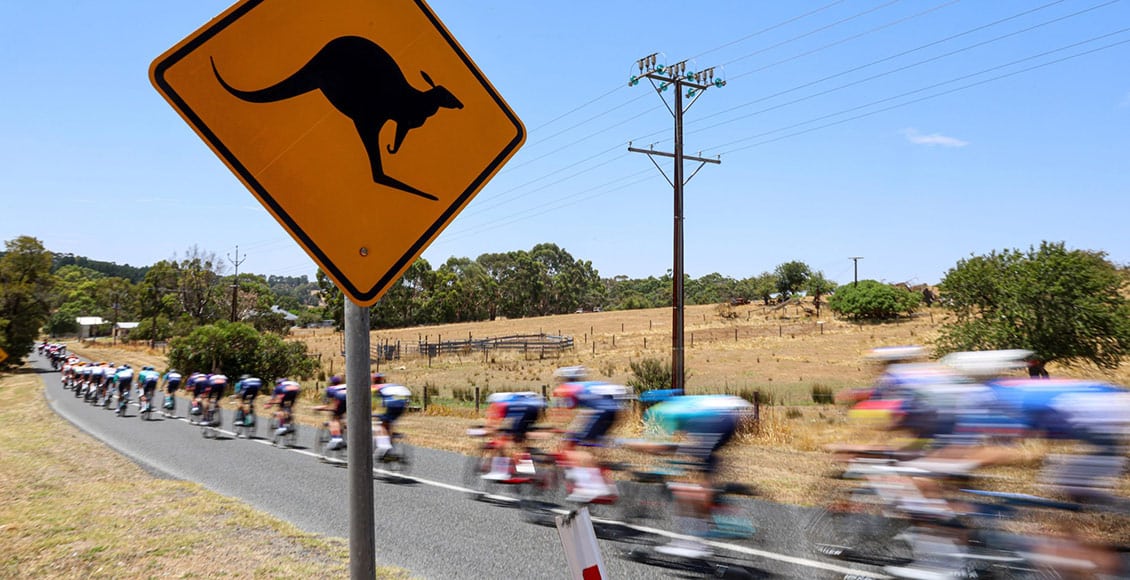
Amid the rush of races that kicked off the 2026 road season this past week, the Tour Down Under once again did what it has quietly become very good at: setting the WorldTour’s tone. And that message was again blunt as UAE Team Emirates-XRG, which has won the last two Tours de France along with a large share of all the one-day Monuments, remains in a different competitive universe from the rest of the peloton. The race’s overall winner, Jay Vine, represents the clearest expression yet of just how wide that gap has become. Vine’s performances were not merely winning rides; they were “statement” rides – controlled, repeatable, and almost casual in terms of how they dismantled the best-laid plans of rival teams. Even with a mild, non-climber-friendly course and the race’s lone summit finish cancelled due to extreme heat, Vine still won the general classification by more than a minute. That margin is startling when we consider that the average margin of victory over the past two decades has been roughly twelve seconds. When a rider who is not even one of the declared GC leaders on his team can show up and decisively beat all the top rivals, it reframes the entire discussion.

The other major takeaway from TDU was how thoroughly the sport’s superteams controlled the race. The combination of UAE, Visma–Lease a Bike, and INEOS Grenadiers claimed most of the six stages. More broadly, the event highlighted that races can succeed with relatively simple but creative course design, particularly when built around a central start-and-finish hub and paired with strong engagement from the local cycling community. Still, the 2026 edition will largely be remembered for the absence of its traditional centerpiece – the ascent of Willunga Hill. The queen stage had to be shortened and effectively neutralized due to extreme heat. While the decision was handled with clear and effective communication between race organizers, teams, and riders, the implications for the rest of the calendar are concerning. Frequent episodes of extreme heat have become a significant risk, especially regarding the 2026 Vuelta a España which is heavily anchored in southern Spain’s late August and September climate. Organizers of that race may be forced to choose between rethinking both the timing and course design, or accepting that large portions of its traditional map may no longer be viable.

The World Economic Forum (“Davos”) released a study last week billed as the first real attempt to properly measure the size of the global sports industry. Conducted in conjunction with the British management consultancy Oliver Wyman, the report suggests that the global sports industry will grow from $2.3 trillion in 2025 to some $3.7 trillion in 2030. But it also highlights a number of risks going forward, including current trends away from physical activity – with one in three adults now defined as “inactive.” This is a direct threat to major sports-related brands like Nike, but it will impact everyone “from fitness instructors to golf-course owners, not to mention the increased strain on national healthcare budgets.” The other major risk highlighted by the report is the range of threats posed by on-going climate change, underlining the fact that “elite sport needs stable weather patterns.” The report suggests that sport now constitutes some two percent of world GDP, and “supports” one in every 25 jobs. The rising value of sports franchises and leagues is gradually transforming the industry into a formal new investment “asset class.” But the study also warns that sport should utilize its platform, exposure, and influence to encourage more active physical and environmentally sustainable behavior, or the industry could risk a $1.6 trillion decline by 2050.
 Puck Pieterse’s late season hot form will challenge Brand at the CX Worlds.
The last few rounds of the UCI’s cyclocross World Cup (and related Belgian series and national championships) have cemented expectations for the upcoming men’s world championship event, but upended trends in the women’s field. Mathieu van der Poel has performed at a level above the rest throughout the men’s campaign, usually sizing the field up for a lap or two, then turning on the jets to build and sustain a gap for the victory. One gets the feeling while watching Van der Poel that his “full gas” is perhaps just 80% of his potential Monument-winning output, but his combination of power and effortless skill (again) puts him as the frontrunner for another CX rainbow jersey. On the women’s side, Lucinda Brand’s recent dip in form and health has re-opened the talk about who is the world championship frontrunner. Brand’s UCI World Cup overall points win was never really in doubt after winning eight of the twelve rounds, but several key rivals have come into form late – none more so than Dutch compatriot Puck Pieterse, who won the Maasmechelen and Hoogerheide series-ending events this past weekend. The men’s world championship race might be a case of betting on second place and enjoying the MvdP show, but the women’s race? All bets are off, and it might just be the best race to watch all weekend in Hulst.
A recent report from EY Consultants, highlighting key trends in the media and entertainment industry, drew attention to several sports-related phenomena in transition at the moment. First, the report suggested that streaming and standard linear coverage may converge as consumers demand seamless and more simplified experiences. Second, while AI may accelerate production, authenticity is becoming the industry’s most sought-after asset. Finally, “experiential entertainment” is shifting from a sidelight into a strategic priority over time. “Prediction” markets are growing, even as several major sports betting scandals have highlighted the integrity risks in gambling. The universe of sports media continues to expand, particularly in terms of new women’s leagues, and will continue to reshape rights negotiations and partnership strategies. Finally, podcasts are starting to represent far more than a niche engagement strategy – with total industry valuation booming from about $8 billion in 2024 to an estimated $40 billion in 2029.

An interesting recent political analysis of major sports attempted to break down the political leanings of key professional athletes. Although it is often assumed that politics should be kept out of sports, and while most professional athletes don’t typically discuss their political views, voter registration records of professional athletes are easily obtainable in many states. This particular study identified the WNBA women’s basketball league as having the highest percentage of registered Democrats at some 68% of the total player population. The NBA was next at 43% and the NFL at 34%. Hockey and Major League Baseball showed a single-digit registered Democratic base and a registered Republican base in the 50% range. While raising some interesting political and cultural questions, these figures are limited by the fact that several key states, including Texas and California (certainly key states in terms of pro sports) do not make voter files publicly accessible.
Demographic analysis also helps to explain some of the differences. For example, only six percent of MLB is Black, while the Latino participation is almost 30%, many of whom are foreign-born and hence do not vote. The partisanship in the National Hockey League is also interesting, where only five percent were listed as Democrats, but only about one-third of the total player population was represented. Perhaps the most interesting finding was that when all five major leagues were combined, the percentage of athletes identifying as “independent” was over 40%, compared to the national average of just 27%. “This could indicate that political engagement is lower, or that athletes are hiding their true affiliations with the awareness that they are public figures.”
Indiana University’s recent NCAA football national championship exposed the benefits and flaws of a salary cap in pro sports. And yes, we just used “pro sports” and “NCAA” in the same sentence because the bird formerly known as “elite amateur” flew the sports coop when House vs. NCAA was legally settled. Universities are currently capped at sharing $20.5 million annually with their athletes, but can allocate name/image/likeness (NIL) payments that are limited only by how much boosters and donors are willing to donate – and the creativity by which the NIL sources classify such payments as “valid business expenses” and are fair market value for the player. As expected, the top schools in each of the Power Conferences spent lavishly to hoard the best players – so-called ‘five star’ recruits – and predictably comprised the majority of teams in the College Football Playoffs. However, Indiana boasted no five star recruits and yet completed one of the rarest sporting feats: an undefeated championship season. The team’s superior coaching, strategic and controlled spending, and complete focus on a championship set it apart from other NCAA programs over the past two seasons and demonstrated that “spending more” doesn’t translate into “winning more.”
Mark Cuban, the billionaire NIL booster behind Indiana’s football success, sees the salary cap as a guardrail which levels at least part of the playing field in a thinly regulated collegiate sports market. A flaw of the newly professional collegiate football landscape is the wild west “transfer” period to acquire and retain talent at any cost necessary; athletes already being paid by one school commit to another one for more money, constantly shifting talent across the Power Conferences without building continuity in one team or the other’s success. One school has even gone to the lengths of threatening to sue one of its star recruits for breaking a “contract” to play for the school. According to Cuban, who is also a longstanding NBA team owner, a salary cap “makes you think more. You have to be more strategic, you have to be more tactical. It protects us from ourselves… It’s not even how much any given alumni gives or the whole [of] all the money they collect – it’s how it’s spent. And you can create a lot of misaligned incentives if there isn’t some form of control.”
Key concepts of the NCAA’s salary cap model are immediately applicable to the spending race within pro cycling that has polarized the talent – and wins – among just a handful of highly capitalized WorldTour teams. A ceiling might encourage more strategic spending by the teams while contract regulations could put meaningful guardrails on non-team remuneration strategies, like the agreement Mathieu van der Poel and Canyon bicycles maintain to reduce his team’s exposure to his otherwise considerable open market value. Ultimately, a successful salary cap in pro cycling may only be possible once revenue streams diversify beyond sponsorship commitments, but a capped framework might be a way to achieve that goal through better talent distribution and more exciting racing – leading to an enticing televised product and increased fan interest to boost the sport’s economic growth.
A disturbing report last week highlighted the risk to sports from intentional disinformation on the internet. Citing examples from the mainstream media and tennis, a report from the Althea Group, which tracks digital misinformation, “uncovered a sprawling ecosystem of inauthentic networks pushing fabricated stories across social platforms, targeting major U.S. professional sports league—the NFL, MLB, NBA, WNBA, and NASCAR.” Key sports figures have had to publicly deny fabricated stories or quotes, often about polarizing political statements. Although, as Kaplan points out, cycling is less likely to be targeted for such misinformation campaigns simply because of its relatively small fan base and commercial size, we in cycling should nevertheless be aware and alert to the potential implications.
Written and Edited by Steve Maxwell / Joe Harris / Spencer Martin
THE OUTER LINE
www.theouterline.com
@theouterline
Visit our website for our latest articles and commentary. And check out our extensive Article Library for hundreds of in-depth articles about the economics, governance, structure and competition of pro cycling, organized by subject. (Advisory Group: Peter Abraham, Luke Beatty, Brian Cookson OBE, Nicola Cranmer, Prof. Roger Pielke, Jr., Dr. Bill Apollo and Prof. Daam Van Reeth.)
The post A New Season, Familiar Fault Lines: What TDU 2026 Revealed About Pro Cycling’s Future | The OUTER Line appeared first on PezCycling News.